







India’s Logistics’ transformation is amazing
With a growth rate of 6.2% year on year, India’s manufacturing industry is growing at a rapid speed. Currently it accounts for nearly 17% of India’s GDP. To move this […]


Table Of Content
With a growth rate of 6.2% year on year, India's manufacturing industry is growing at a rapid speed. Currently it accounts for nearly 17% of India's GDP. To move this huge volume of finished products, a robust logistics industry is making it possible. From domestic appliances to automotive parts and automobiles, this industry serves diverse clients across different businesses. To achieve timely and systematic delivery of huge quantities of goods, they maintain massive warehouses fully equipped with modern-day equipment — made possible by autonomous mobile robots, automated guided vehicles, conveyors and automated cranes. India's logistics sector is currently valued at roughly $246 billion to $315 billion. The industry is rapidly expanding at a Compound Annual Growth Rate (CAGR) of 8% to 11% and employs over 22 million people.
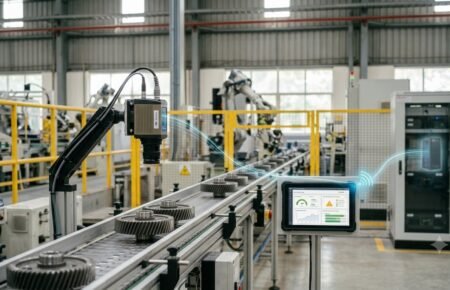
India's warehousing sector is undergoing rapid expansion, driven by the e-commerce boom, organized retail growth and the increasing need for efficient inventory management. These are no longer just large storage rooms filled with inventory — modern facilities are smart, agile, and built to power the seamless movement of goods from factory to consumer. Some are as big as 10 lakh square feet. Sachin Haritash, Director of Chetak Logistics, India's leading automotive logistics company, says they have every facility including Assistive Picking Robots, Automated Guided Vehicles, and AI-powered predictive analytics for inventory management. He explains that warehouses today are so large that moving a product from one corner to another requires an intelligent system. Conveyor belts scan the barcode on each item and immediately segregate it according to pin code, from where small robots running on magnetic strips stack them at their pre-decided location. Larger material is carried by automatic forklifts to an identified spot. Automated trucks then move material or parts between warehouses — carrying components like chassis and engines, made at different plants, to assembly locations.

"When warehouses span nearly a million square feet, automation isn't a luxury, it's the only way to ensure accuracy, speed and operational efficiency."— Sachin Haritash, Director, Chetak Logistics
Why the World Is Moving from Forklifts to Robots
Naresh Rattan, former CMO–Honda India & Bangladesh, President & COO–Force Motors, and Consultant for Leadership Management International (USA) and SMI Japan, believes the starting point is understanding why the world is moving from forklifts to robots in warehouse operations. Earlier, warehouses were simply storage facilities. Today, they are expected to become intelligent fulfilment centres capable of delivering products faster, more accurately and at a lower cost. The rapid growth of e-commerce, increasing global competition, labour shortages in many countries and rising customer expectations for speed and efficiency are driving this transformation across the world.
Based on his visits to countries such as Japan, Singapore and China, Rattan has observed that companies from the United States, Germany, South Korea and Taiwan are investing heavily in warehouse automation. Global organisations such as Amazon, Walmart, Alibaba and DHL have widely adopted robotics, artificial intelligence (AI) and intelligent warehousing systems — setting the new global benchmark. In many developed countries, labour shortages make automation economically viable, enabling companies to recover their investments relatively quickly, evolving warehouses from labour-intensive operations into fully digital, automated and AI-driven facilities.
Over the past five years, India has made considerable progress, though most warehouses still rely heavily on forklifts, manual material movement and labour-intensive operations. With the implementation of the National Logistics Policy, the Make in India initiative, the rapid growth of e-commerce and expansion in manufacturing, many Indian organisations have now entered the automation phase. Larger companies are already investing in robotics, warehouse management systems and automated material-handling equipment, and AI-enabled warehouse management systems are gradually becoming more common.
Some of the key business technologies being adopted globally — and increasingly in India — include Warehouse Management Systems (WMS), Radio Frequency Identification (RFID), the Internet of Things (IoT), Artificial Intelligence (AI), Autonomous Mobile Robots (AMRs) and Automated Guided Vehicles (AGVs).
Automation as a Productivity Multiplier, Not a Job Cutter
In a country like India, automation is not necessarily about reducing manpower. India is a fast-growing economy with a large and expanding workforce, and economic growth is expected to continue over the next 15 to 20 years. The period from 2024 to 2047 represents India's journey towards becoming a developed nation, and during this growth phase, automation should be viewed as a means of improving productivity rather than replacing people.
Automation enhances inventory accuracy, delivery precision, workplace safety, space utilisation and overall operational efficiency. It also enables faster deliveries and higher customer satisfaction, strengthening India's competitiveness against developed economies such as Japan, Germany, the United States and China.
Rattan notes that logistics costs in China are estimated at around 8-9 per cent of GDP, whereas India's logistics costs have traditionally been around 14-15 per cent, although they are gradually declining. Even a one per cent reduction in logistics costs can substantially improve India's manufacturing competitiveness and export potential — and stronger exports are essential for supporting long-term economic growth. Warehouse automation requires investment, but in many cases the returns are realised through higher productivity, improved accuracy and fewer operational errors within three to five years.
There are, however, several challenges: high capital investment, technology integration, the availability of skilled personnel to operate and maintain automated systems, effective change management and cybersecurity. Technology alone cannot transform a warehouse — people, processes and technology must evolve together.
Looking ahead, over the next decade — and certainly by 2047 — Indian warehouses are expected to become intelligent ecosystems where AI, robotics, data analytics and human expertise work together seamlessly. Warehouse managers will spend less time supervising routine material movement and more time making strategic business decisions. The companies that succeed will be those that integrate technology, people, robotics and operational excellence most effectively.

"Warehouse automation is not about replacing people, it is about improving productivity, reducing logistics costs and making Indian manufacturing globally competitive."— Naresh Rattan, Former CMO – Honda India & Bangladesh; President & COO – Force Motors
The Industry 5.0 Lens: Dark Warehouses and Self-Optimising Ecosystems
Dr Srinivas Padmanabhuni, CTO, AiEnsured, says Industry 5.0 is transforming global logistics by combining human-centric AI with end-to-end automation, enabling facilities to move beyond forklift-dependent operations. China is leading this transformation through what are known as "dark warehouses" and highly automated seaports, where interconnected robotic systems operate with minimal human intervention, significantly improving both throughput and safety.
A notable example is the Yangshan Deep-Water Port in Shanghai, a $20 billion project that deploys Automated Robotic Cranes (ARCs) to manage container movement at scale. Such facilities also rely on fleets of Autonomous Mobile Robots (AMRs) for real-time inventory movement and navigation, reducing errors and improving response times well beyond the capabilities of traditional warehouse operations.
What ties these technological advancements together is the underlying monitoring infrastructure. Platforms such as Prometheus enable continuous performance monitoring across automated systems, ensuring reliability and operational efficiency at scale. Together, these developments reflect the defining shift of the next industrial revolution: not merely automation, but intelligent, self-optimising ecosystems in which humans supervise and make strategic decisions, while autonomous systems execute routine operations with speed, precision and efficiency.

"The future of logistics is not fully autonomous. It is intelligently collaborative, where humans make strategic decisions while AI-powered systems execute with speed, precision and scale."— Dr. Srinivas Padmanabhuni, CTO, AiEnsured
Conclusion
India is poised to automate its logistics industry by leveraging AI and data analytics. Warehouse automation is not about replacing people; it is about empowering them — reducing waste, improving productivity and making Indian logistics smarter, faster, safer and globally competitive. Large companies are leading the way, and in the coming years we will see even greater automation. With its strong IT capabilities and growing expertise in AI, India has a unique opportunity to develop intelligent supply chains and emerge as one of the world's leading logistics and manufacturing economies.