








Energy Management Systems on the Factory Floor: From Monitoring to Optimisation
For years, energy management in manufacturing was largely a reporting exercise. Plants collected electricity bills, conducted periodic energy audits, tracked monthly consumption and looked for...

For years, energy management in manufacturing was largely a reporting exercise. Plants collected electricity bills, conducted periodic energy audits, tracked monthly consumption and looked for obvious inefficiencies: an oversized motor, a leaking compressed-air line, an inefficient chiller or equipment left running during idle periods.
That model is becoming inadequate.
The modern factory does not consume energy at a steady rate. Its demand moves with production schedules, machine states, batch cycles, ambient conditions, compressed-air requirements, heating and cooling loads, and increasingly, onsite generation and storage. Two production days with the same output can therefore have very different energy profiles. This is where an Energy Management System (EMS) becomes more than a dashboard.
A mature industrial EMS should help a plant move through three stages: know what is happening, understand why it is happening, and influence what happens next.
Monitoring is only the starting point
The first job of an EMS is visibility. A factory may know how much electricity it consumed in a month, but that number alone tells very little about where energy was used or whether it was used productively.
A modern EMS therefore pushes measurement deeper into the plant through submeters and connected equipment. Main incomers can be broken down into production lines, CNC machines, compressors, chillers, furnaces, HVAC systems, pumps, utilities and other significant energy users.
The objective is not simply to generate more data. It is to establish a sufficiently granular picture of energy versus production activity. That distinction matters.
If a machining line consumes 10,000 kWh in a shift, the meaningful question is not whether 10,000 kWh is “high.” It is whether that energy consumption is reasonable for the number and type of parts produced, the machine utilisation, operating conditions and process requirements.
ISO 50001 international standard for Energy Management systems (EnMS) provides a useful framework here, It calls for systematic improvement of energy performance and uses concepts such as Energy Performance Indicators (EnPIs) and Energy Baselines (EnBs) to measure improvement. ISO 50006:2023 lays down the Energy management guide specifically for establishing and maintaining these indicators and baselines.
The factory needs an energy model, not just meters
This is where many EMS projects become overly focused on dashboards. Installing hundreds of meters does not automatically create energy intelligence. The difficult part is establishing relationships between energy consumption and the variables that drive it.
A chiller’s power consumption may depend on ambient temperature, chilled-water demand and production load. A compressor’s behaviour may be linked to pressure requirements and leakage. A CNC machine’s consumption can vary significantly between cutting, rapid movement, spindle operation and idle states.
This is why submetering needs to be designed around the factory’s significant energy uses, rather than simply deployed wherever measurement is technically convenient. Research on industrial submetering has similarly highlighted the distinction between collecting data and collecting data that can actually generate actionable energy savings. The EMS should therefore connect energy data with operational context.
Production data can come from the MES. Machine status can come from PLCs or SCADA. Production orders can come from ERP. Environmental conditions can come from sensors. Utility information can provide tariff and demand signals.
The architecture matters
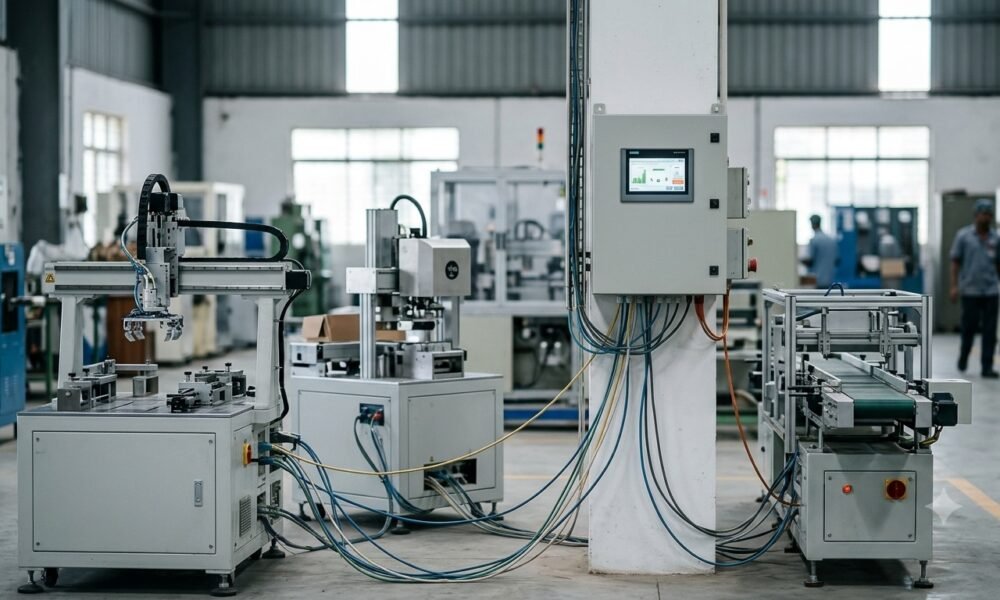
At the factory-floor level, an EMS is best viewed as a layered system rather than a single software application. At the bottom are meters and sensors measuring electrical parameters, gas, steam, compressed air, water or thermal energy where relevant.
Above that sit edge devices and gateways, which collect data from equipment and industrial protocols such as Modbus and communicate with higher-level systems. SCADA and historians can provide operational context and time-series data, while the EMS adds energy-specific analytics, baselining, alarms and performance indicators.
The next layer is integration.
Connecting the EMS with MES and ERP systems allows energy to be associated with production orders, batches, machines and schedules. This is where energy management starts becoming an operational discipline rather than a sustainability application.
NIST’s work on smart manufacturing similarly emphasises the importance of real-time information, performance measurement and the ability to use operational data for analysis, decision-making and control.
The architecture should also be open enough to avoid creating another isolated data silo.
An EMS that cannot communicate with the plant’s existing automation infrastructure may produce attractive reports while remaining disconnected from the decisions that actually influence energy consumption.
The next step is proactively looking to arrest wastage
Once an EMS has established a baseline, analytics can begin identifying abnormal behaviour.
Consider a compressed-air system. Energy consumption may rise gradually while production remains unchanged. Without continuous monitoring, the increase may only become visible when the monthly electricity bill arrives.
An EMS can flag the divergence much earlier.
The same principle applies to motors, pumps, chillers and HVAC systems. A gradual change in the energy signature can indicate equipment degradation, control problems, excessive idling or process instability. This is where energy management begins to overlap with condition monitoring and predictive maintenance.
The factory is no longer asking only whether a machine has failed. It can start asking whether the machine is consuming unusually high energy for the work it is performing. Recent research is pushing this concept further, with high-resolution electrical measurements being used to identify machine operating states and process behaviour at individual manufacturing assets.
The important caveat is that higher-frequency data is not automatically better. The measurement architecture should be designed around the decision the plant wants to make.
The biggest mistake is treating EMS as an IT project
Energy management ultimately belongs neither exclusively to the IT department nor to the sustainability team. It sits at the intersection of operations, electrical engineering, maintenance, production, finance and increasingly digital engineering.
The plant manager wants reliable production. The maintenance team wants equipment visibility. The energy manager wants lower consumption and better performance. Finance wants predictable energy costs. Sustainability teams want credible emissions data. An effective EMS has to connect those objectives rather than create another dashboard for each department.
That also changes how projects should be implemented. Instead of attempting to instrument an entire plant immediately, manufacturers can begin with a few significant energy users, establish meaningful baselines and demonstrate measurable improvements. The architecture can then expand as the organisation develops confidence and capability.
From dashboard to closed-loop factory
The real maturity test for an EMS is therefore not how many meters it can display. It is whether the system changes decisions. A basic system tells an engineer that a compressor is consuming more energy. A better system identifies that its energy intensity has deviated from the expected baseline. A more advanced system identifies the likely cause. An optimisation layer recommends the appropriate operating change.
And a mature system can eventually execute that change within defined operational and safety limits. That is the progression from monitoring to optimisation. The future of factory energy management is unlikely to be another wall-mounted dashboard showing colourful consumption charts. It will be a layer of operational intelligence increasingly embedded into the way factories schedule production, operate equipment, manage utilities and balance energy resources.
The fundamental shift is simple but significant: Energy should no longer be treated as something the factory measures after production. It should become a variable the factory actively manages while production is happening.
That is when an EMS stops being an energy-reporting system and starts becoming part of the factory’s control strategy.