







Predictive Maintenance Moves Into the Hazard Zone
Predictive maintenance has spent years proving its value in ordinary industrial environments. The harder frontier is equipment that maintenance teams cannot easily monitor. Refineries, chemical...

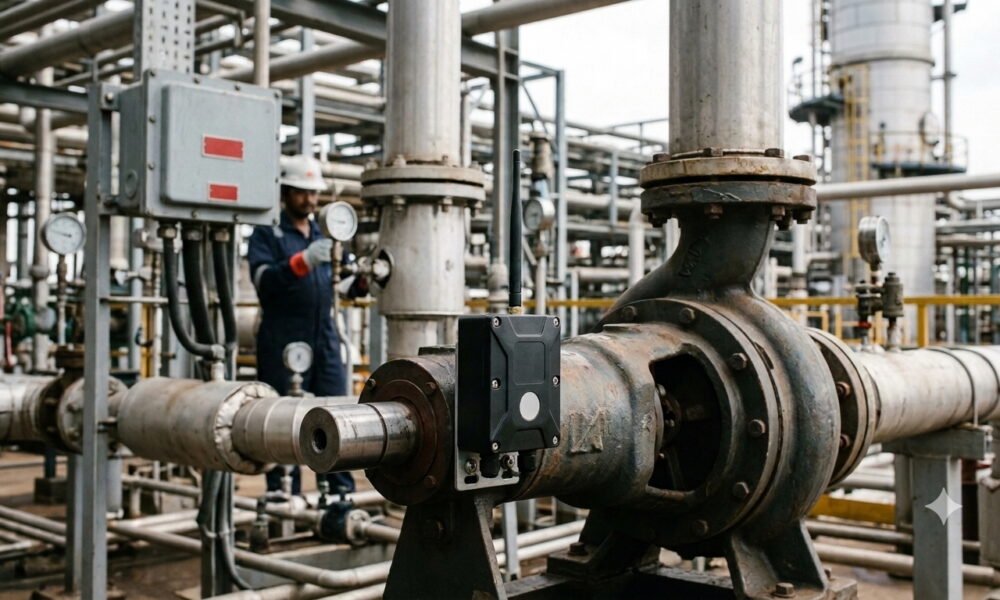
Predictive maintenance has spent years proving its value in ordinary industrial environments. The harder frontier is equipment that maintenance teams cannot easily monitor.
Refineries, chemical plants, mining operations, grain handling facilities and other process industries contain assets operating in areas where a failed component isn’t simply a maintenance problem. A spark, excessive temperature or unsuitable electrical device can introduce an ignition risk. At the same time, sending technicians into these areas for routine inspection carries its own exposure and operational cost.
That creates a difficult reliability equation: the equipment that may need the closest monitoring is often the equipment that is hardest to monitor continuously.
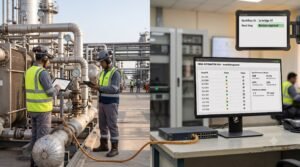
Wireless, hazardous-area-certified condition-monitoring technology is beginning to change that equation. Instead of relying exclusively on periodic inspection rounds, plants place sensors on critical assets and continuously collect signals such as pressure, vibration and temperature, then use analytics to identify developing faults.
The opportunity is significant, but so are the engineering constraints. Predictive maintenance in a hazardous area is not simply a conventional condition-monitoring system with a special sensor attached. Classification, certification, installation method, communications, cybersecurity, battery life and the actual operating environment all have to line up.
Why hazardous areas have remained a monitoring blind spot
A conventional predictive-maintenance programme typically starts with sensors attached to pumps, motors, compressors, fans or other rotating equipment. Data is collected continuously and analysed for changes associated with bearing wear, imbalance, misalignment, lubrication problems or other developing faults.
The problem changes when those machines sit in a classified area.
IS 5572 published by BIS lay down the hazardous locations according to the zones based on presence or potential presence of flammable gases, vapours, liquids or combustible dusts, any equipment electrical or otherwise installed there must be intrinsically safe, approved for the relevant hazardous location or otherwise demonstrated to be safe for that environment. Importantly, the approval has to correspond to the actual class and the ignitable or combustible properties involved as per the standard for e.g. : OISD-STD -113 and should carry the specific industry approval certificate for e.g. PESO.
That requirement immediately narrows the equipment that can be deployed.
A plant may know exactly which compressor it wants to monitor, but that does not mean it can simply attach an off-the-shelf wireless vibration sensor and start collecting data.
The sensor itself has to be suitable for the area.
And the installation has to make operational sense.
This is one reason manual inspection rounds continue to remain common. A technician can enter a classified area using the required procedures and approved equipment, collect readings and leave. It is familiar, but it provides only a snapshot.
A fault developing immediately after an inspection may remain invisible until the next round.
That is the fundamental weakness continuous monitoring is trying to address.
Safety changes the maintenance equation
The case for continuous monitoring in hazardous areas is not only about avoiding equipment failure.
It is also about reducing the number of times people need to enter the hazardous environment for routine inspection.
IS 18001 / IS/ISO 45001 elaborate the hierarchy of controls places engineering controls above administrative controls and PPE because engineering approaches can isolate people from hazards without relying as heavily on individual behaviour.
Manual inspection is, by nature, dependent on a person following the required procedure at the required time.
Continuous remote monitoring changes that model. If an appropriately certified sensor can remain installed on an asset and transmit its condition data without requiring a technician to repeatedly access the equipment, the monitoring task itself becomes less dependent on physical exposure.
That does not mean sensors eliminate the need for inspections, maintenance or personnel. They do not.
The more realistic benefit is that technicians can spend less time collecting routine condition data and more time investigating actual abnormalities and carrying out planned maintenance.
For hazardous facilities, that distinction can be particularly valuable.
The technology stack has to work as one
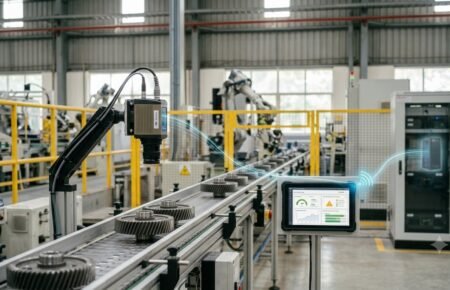
A hazardous-area predictive-maintenance system generally has four layers:
Sensing. Sensors capture machine-condition information such as vibration and temperature.
Communication. Data has to leave the classified area through an appropriate wireless or wired architecture.
Analytics. Software interprets the measurements and identifies patterns associated with developing faults.
Maintenance workflow. Findings have to reach the people who can act on them.
A sophisticated sensor does not create a predictive-maintenance programme by itself.
The real value appears when a change in machine behaviour becomes an actionable maintenance finding.
For example, a rising vibration pattern on a pump may be insignificant in isolation. When the system understands the pump’s operating characteristics and identifies a frequency pattern associated with a bearing fault, the maintenance team has something more useful than a generic “high vibration” alarm.
That distinction matters in busy plants where dozens or hundreds of machines generate mechanical and electrical noise.
The objective is not to generate more alarms but to make better decisions .
Why wireless matters more in a hazardous area
Wiring a sensor into a conventional industrial system can involve significantly more infrastructure than simply mounting the sensor.
In a classified location, cable routing, conduit, junctions, installation methods and shutdown requirements can all affect the project.
Wireless technology can remove some of that physical infrastructure.
But wireless does not mean “installation without constraints.” The sensor still needs the appropriate hazardous-area certification, while the communications architecture must be designed around the plant’s physical environment.
Metal structures, process equipment, walls, pipework and other obstructions can affect radio performance. A manufacturer’s headline transmission range therefore tells only part of the story.
The actual installation needs a site assessment.
This is also where battery life becomes more important than it might appear.
An equipment that needs frequent battery replacement creates a recurring reason for personnel to access the hazardous area. Long-life battery operation can therefore be a practical safety feature as much as a maintenance convenience.
Certification is not a sticker
One of the biggest risks in evaluating hazardous-area monitoring technology is treating certification as a universal label which it isn’t.
Under the IS/IEC system, gas hazards and combustible dust environments are classified according to the continued exposure, likelihood and duration of an explosive atmosphere. The documentation also links these zones to corresponding Equipment Protection Levels.
A facility needs to establish its actual classification first and then verify that the proposed equipment is certified for it.That is why “hazardous-rated” is not a sufficient purchasing specification. The certification documentation matters.
Where predictive maintenance can make the biggest difference
The technology is most compelling when three conditions overlap:
The asset is critical. A failure has a meaningful production or safety consequence.
The asset is difficult to monitor. Access is restricted, hazardous or operationally expensive.
The failure provides detectable warning. Vibration, temperature or other measurable signals change before the asset reaches catastrophic failure.
Rotating equipment frequently fits that profile.
Pumps, compressors, motors, fans, blowers and agitators can develop detectable mechanical problems before they stop operating completely. In a refinery, the equipment may sit inside a classified hydrocarbon-processing area. In a food facility, combustible dust may create a different hazard profile. In mining, the combination of methane and combustible dust can create another.
The physical environments differ, but the reliability problem is remarkably similar. A critical rotating asset is deteriorating, and the same needs to be known before the failure becomes urgent.
The business case is bigger than avoiding repairs
Predictive maintenance is often sold around maintenance savings. Hazardous-area applications add several other variables.
An early warning can give maintenance teams time to make parts available, schedule labour, coordinate permits and plan an intervention around production.
An unexpected failure does the opposite. In a hazardous process plant, the cost of an outage can also extend beyond the repair itself.
AI is useful only if it improves the signal-to-decision ratio
Adding AI to condition monitoring does not automatically make the system predictive. The challenge is turning large amounts of sensor data into findings maintenance teams can trust.
More advanced diagnostic systems attempt to understand the machine’s normal operating behaviour and identify specific changes associated with known failure modes. That can reduce the problem of alarm overload.
Bearing type, rotational speed, equipment geometry and historical condition data can all improve diagnostic interpretation. The technology therefore works best when the sensor, analytics platform and maintenance workflow are treated as a single system.
Thinking Cybersecurity too
Moving condition-monitoring data wirelessly does not remove cybersecurity requirements. It creates another connected pathway into an industrial environment.
That means plants should examine encryption, authentication, network segmentation, access controls, software update procedures and how the monitoring platform connects with existing operational technology.
IEC 62443 is specifically focused on cybersecurity for industrial automation and control systems, making recognised industrial cybersecurity practices an important part of evaluating connected monitoring architecture.
This is especially relevant when monitoring systems eventually integrate with maintenance-management platforms or other plant systems. The objective should be controlled visibility, not simply more connectivity.
From inspection rounds to continuous visibility
The most important change in hazardous-area predictive maintenance is the change in maintenance behaviour.
Asking “How has the machine’s condition changed since the last measurement?” gives reliability teams a much better chance of identifying deterioration early, planning the intervention and avoiding an emergency response.
It also changes the safety equation. Every routine inspection that can be replaced by reliable remote condition visibility is a potential reduction in personnel exposure provided the monitoring technology itself is correctly certified, installed and maintained.
Hazardous environments will never become ordinary industrial environments simply because they are connected. The standards remain. The classifications remain. The risks remain. But the monitoring gap is becoming less difficult to close.
The next step in predictive maintenance is therefore not simply putting more sensors on machines. It is extending reliable, certified condition intelligence into the places where failures are most expensive and where sending people to look for them carries a cost of its own.