






Connect Legacy Machines to Modern Digital Workflows: Modernise the Factory Without Starting from Scratch
A practical approach to industrial digitalisation is emerging: retain proven equipment, bridge connectivity gaps and turn shop-floor data into information that production, maintenance and business...

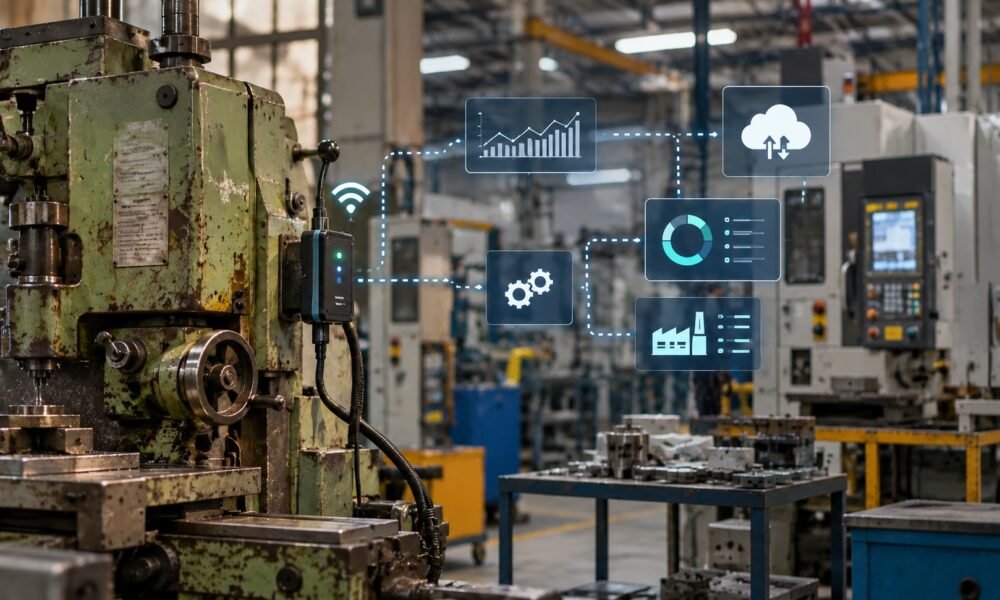
A practical approach to industrial digitalisation is emerging: retain proven equipment, bridge connectivity gaps and turn shop-floor data into information that production, maintenance and business teams can act on.
The digital gap in a factory often hides in plain sight
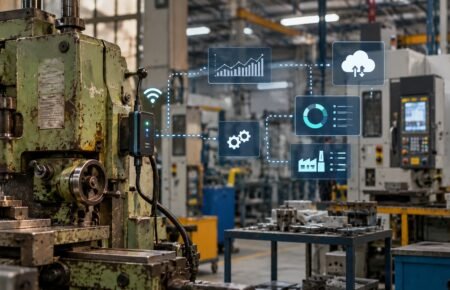
A machine doesn’t need to be connected to an internet, a touch screen, or an artificial intelligence platform to be productive. Most of the traditional CNC machine, presses, conveyors, packaging line and process control systems still provide a reliable output long after installing the original controls. Where the rest of the factory goes, the problem starts.
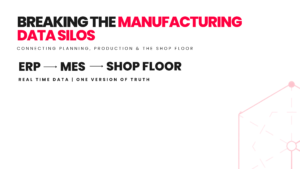
Production planning moves to the manufacturing execution system (MES). Business Orders and inventory are controlled using enterprise resource planning (ERP) software. A digital work order is used by maintenance teams and a real-time production report is expected by management. However, an older machine can exchange information using a proprietary controller, a serial interface or signals that convey only limited information such as being on or off.
The result is a “digital divide” within the same facility. Equipment that can’t readily communicate its operating status, production counts, alarms or performance data is used in modern business applications. Paper logs, spreadsheets, manual readings and phone calls fill the void of operators.
This is not just a nuisance. Information is sometimes delayed and it can be more difficult to pinpoint repeat stoppages, reconcile output, find out why one production line is under-performing another.
It’s not always the case that you need to replace all of your older machines. Even though it’s an established piece of equipment, it might still be in good mechanical condition, be appropriate for the product, and have experienced operators. The real challenge now is how to integrate it with today’s workflows without adding any extra investment costs or causing disruptions in production.
Connectivity starts with understanding the machine
Manufacturers should first determine what their current equipment can communicate before choosing a gateway and/or sensor or software platform. Even if the PLCs were installed many years ago, they may provide some useful operating data on some machines. Others come with CNC controls, industrial PCs or communication ports that can be used via a compatible interface. Older or simpler equipment may only generate electrical signals, and then more sensors will be needed to obtain operating conditions.
The differences in these dictate the best integration solution. If the machine has an accessible controller then it can be connected using a supported industrial protocol. If the machine has limited digital interfaces, it may require a retrofit gateway or further data acquisition components or non-invasive sensors to monitor parameters like vibration, temperature, current or cycle activity.
This is important since connectivity should be tailored to the machine, not mandated. Manufacturers should first determine what signals are available, the controller’s limitations and whether the collection of necessary information will impact existing control functions. They should also be able to identify data which can be read immediately and data to be determined from physical measurements.
For example, knowing that a motor is connected to a power supply and is consuming power is a sign that equipment is running, but doesn’t necessarily mean that good parts are being produced. Likewise, a cycle counter can be counting cycles and not differentiate if it is doing them at the correct rate. It’s important to understand these limitations before the data can end up in a dashboard, so that the quality of the digital workflow can be ensured.
Building the bridge between machines and software
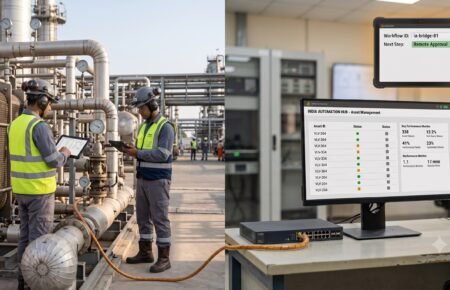
After the equipment is evaluated, the next challenge is to develop the dependable pathway from the shop floor to the systems for which it will provide data. This typically entails a mix of industrial communication protocols, connectivity hardware, edge computing and application-level integration.
- Industrial gateways and protocol converters
Gateways are used to join equipment with different communications methods. They are able to receive data from PLCs or CNC controls or field devices, and pass along these data to compatible applications. One of the most beneficial attributes of protocol conversion is that it is beneficial in situations where old devices are unable to communicate directly with the new software.
- Collect and analyze data from the sensors
If the controllers can’t supply enough data, other sensors can detect vibration, temperature, electrical current, pressure, or machine cycle activity. This can be done without replacing an existing control system.
- Edge computing and local data processing
The edge devices process or filter information near the equipment, and then send the information to high-level applications. This can cut down on unnecessary data transfers, enable faster local reactions, and preserve selected functions running without needing to rely on cloud connectivity all time.
These are not mutually exclusive options. A factory can have a protocol converter on one production line, other sensors on a second production line, and a modernised controller on a third. It should be based on equipment condition, information needs, interfaces available and business target.
Why communication standards matter
It is possible to connect to a network, but that is merely the beginning. The data should also be comprehensible to the applications to which it is delivered.
OPC Unified Architecture (OPC UA) and MTConnect are among the standards that contribute to addressing interoperability issues in manufacturing. OPC UA is a structured information exchange framework for industrial systems and MTConnect is a standardized way to represent manufacturing equipment data.
MQTT, on the other hand, is a lightweight messaging protocol that is often used to send data between the connected devices and software applications. It can be integrated into an architecture where machine data is gathered, processed and published to other systems.
These technologies are used for a variety of applications and can be co-used depending on the application. But none is enough for making incompatible equipment work together: device support, data mapping, configuration and testing still remains a key.
NIST’s efforts on MTConnect and OPC UA provide a good example of how standards can enable the talks between equipment and applications that would otherwise be in separate worlds.
From machine data to connected digital workflows
The true power in linking legacy devices is when the information reaches the people and applications that can take action on the information.
Let’s say there is a packaging line that has a high rate of short stops. If the data is not connected, an operator can manually write the interruptions and the maintenance engineer might only be able to see the recurring pattern during a review later on. The factory can record machine stoppages and states with appropriate instrumentation and integration and report on a production dashboard and identify repeated stoppages for investigation.
The Workflows:
Different work flows can be used within the plant from the same data. Production monitoring: A machine state and cycle count can be used to update dashboards to compare actual production with planned production.
Maintenance management: When thresholds are reached based on fault signals, operating hours and sensor readings, inspection requests and maintenance work orders are triggered.
Quality management: Parameters of the respective processes can be linked to the production batch or to the inspection record, thus supporting teams for investigating deviations. This needs the proper traceability and data capture.
Production planning: Production planning can be helped by the availability and output of validated machines and their constraints.
Performance analysis: Run/stop times and production quantities are recorded regularly to help in overall equipment effectiveness (OEE) analysis and identify improvement areas.
Connect what works, modernise what matters
The move to digital manufacturing doesn’t necessarily start with a new production line. It can start with an existing machine that doesn’t have a reliable method of communicating their condition, output or performance to the rest of the business.
At least that gap can be bridged by a number of ways, such as industrial gateways, retrofit sensors, common communication standards and edge computing. Together with proper data practices and incorporation into actual production processes, they can contribute to the successful involvement of existing equipment in a more integrated manufacturing system.
The prudent approach for manufacturers is to be selective, not indiscriminate, and to keep equipment as long as it is still suitable for use, upgrade controls when needed, and coordinate machines within the factory by clearly defined operational requirements.