








5 Signs Your Warehouse Is Ready for Robots: An India Playbook
Warehouse automation in India was considered a domain for the biggest of the e-commerce companies, automotive manufacturers or multinational logistics operators for years. Infrastructure was not...

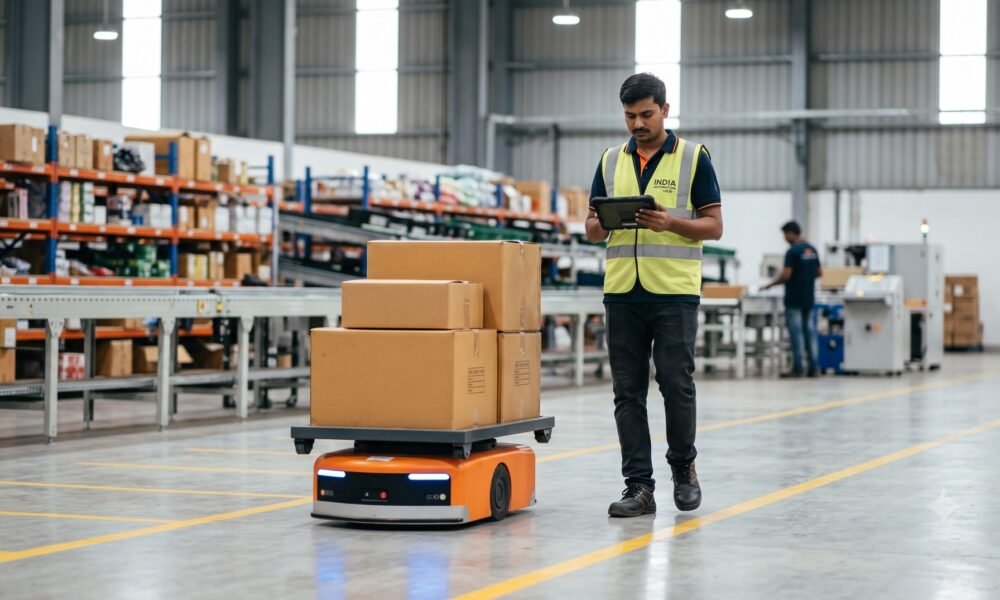
Table Of Content
- 1. Your people are spending too much time moving things that do not need human intelligence
- 2. Peak periods are breaking your operation
- 3. Your warehouse has become too complex for people to manage efficiently
- 4. Your warehouse already has the digital nervous system robots need
- 5. You can identify the problem the robot will solve and calculate what success looks like
Warehouse automation in India was considered a domain for the biggest of the e-commerce companies, automotive manufacturers or multinational logistics operators for years. Infrastructure was not consistent, labour was relatively cheap, and a lot of warehouses were still using a combination of spreadsheets and paper-based systems, along with basic barcode systems. Robots were costly; and infrastructure was inconsistent.
This equation is shifting.
The warehousing industry is growing in India in terms of size, organisation and technology. In 2025, the warehouses in the Grade A/A+ categories reached over 400 million sq ft, and the demand for leasing was still growing. Meanwhile, the manufacturing and e-commerce/3PL sectors are pushing for expedited deliveries and better uniformity.
But there is a key difference in the industry that must be recognized: a new and updated warehouse is not necessarily a ready-to-robots warehouse.
Don’t think they are unearthing a new definition of robotics for operational discipline. In fact, a poorly-designed warehouse might only automate inefficiency if a robot is added to it.
The more interesting question for an Indian warehouse operator is rather “When should we automate?” “When will automation become a cost effective solution to a business problem?”
There are five indications that the response might be yes.
1. Your people are spending too much time moving things that do not need human intelligence
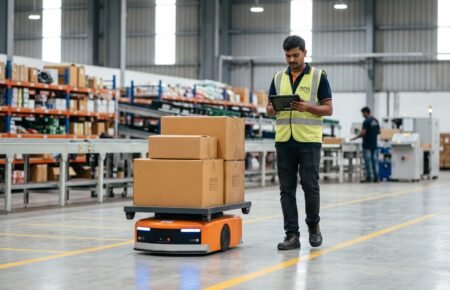
The most obvious, and first sign, is your employees are doing repetitive motion for a big portion of the shift. Think about the typical warehouse activity moving cartons from receiving to storage, transporting totes between picking and packing, replenishing shelves, moving pallets, sorting parcels or taking finished orders towards dispatch.
All of these activities are not necessarily one that demands a complex decision from a human being every few seconds.
But they eat up a lot of man time.
That’s where technologies like AMRs (autonomous mobile robots), AGVs (automated guided vehicles) and robotic pallet movers and automated conveyor systems can begin to make economic sense.
This is not as simple as in the US or Europe because India’s labour market is very different. Labour availability has always been a constraint on the need to replace labour with machines. Study of ecommerce warehouses in India has revealed that despite the huge potential, robotisation is not as prevalent as in many developed markets, partly due to the availability of cheap human workforce.
This is why the prospects of Indian automation cannot just be considered as robots against workers.
With the advent of the physical AI, however, this is even more intriguing. AMRs can now navigate in dynamic environments with increasing ability, instead of a fixed path. This makes them a better fit for Indian warehouses, where layouts, and people and product movements are not usually as uniform as would be found in an automated textbook warehouse.
A period of high activity, or several periods of high activity, is interrupting your operation.
2. Peak periods are breaking your operation
The actual test comes when the demand is at its peak. It could be a big sale for an ecommerce fulfillment centre. In FMCG it can simply be a seasonal demand increase. It may be a sudden shift in demand in a specific area, and for a pharmaceutical distributor, that means a lot. For a 3PL, this could simply be several big customers all coming in at once.
When the response to peak demand is consistently “add more people, add more shifts and pray for productivity”, it might be time to think about reaching an automation threshold.
The trend of large warehouse operations is increasingly gaining ground in India. Colliers noted that demand for industrial and warehousing space in 2025 was relatively evenly split, with large transactions of 200,000 sq ft and more representing approximately 45% of deals and 3PLs, e-commerce and engineering companies being the key drivers of demand.
Scale transforms the economics of automation.
When thousands of movements occur in a small warehouse, a robot that doesn’t look useful in the confined space can prove very useful. This is especially true of goods to person, AMRs, automated sortation and robotic picking.
3. Your warehouse has become too complex for people to manage efficiently
The third sign is less obvious. The issue might not just be about volume. It is complex. Indian warehouses are dealing with increasingly broken-down stocks. The ecommerce has driven huge diversification in SKUs. The concept of quick commerce has set extreme expectations in terms of fulfillment speed. The movement of goods in manufacturing supply chains is becoming more and more just in time. Pharmaceutical and food operations introduce traceability and expiry and temperature factors.
The more products there are, the more decisions there will be. What is the place for an object? What is the best order? What items need to be restocked? How should a mobile robot move? Which is the most important shipment?
Here is where the world of robotics starts blending in with the world of AI, WMS and data analytics.
Robots are not inherently very smart. Weaknesses are overcome when it is integrated into the information layer of the warehouse.
This may be a WMS dictating where stock should go in an AMR, computer vision determining what stock it is, software helping to optimise robot routes or maybe an AI system to prioritise jobs based on urgency.
The warehouse automation market in India is already witnessing a change. Picking and sorting was the most dominant functional segment in 2025, and transportation and AGV/AMR applications are one of the areas that are growing faster.
That is why physical AI has the potential to impact warehouse automation more than traditional, fixed automation.
4. Your warehouse already has the digital nervous system robots need
This could be the most significant sign of all. Never place robots in a warehouse without knowing what is going on in the warehouse. Prior to automation, the warehouse needs reasonably trustworthy digital information on inventory, orders, locations and workflows. However, this doesn’t imply that all Indian warehouses must have a complex AI system.
However, if inventory is in one spreadsheet, order information is in another system and all of the actual physical locations are more or less in workers’ memories, then probably not robotics should be the first investment. The warehouse has to have a digital base. That could include:
- A functioning WMS
- Barcode or RFID tag identification
- Digitised inventory locations
- Reliable order data
The basic warehouse performance metrics are the following:
- Good Wi-Fi or industrial connection
- Incorporate capabilities via APIs.
- Established standard operating procedures and workflows
This is becoming more in tune with the overall logistics modernisation initiative in India. The National Logistics Policy made it clear that digitisation, automation, standardisation, track-and-trace and optimum warehouse planning were all crucial elements to enhance logistics efficiency. It is because of this reason.
5. You can identify the problem the robot will solve and calculate what success looks like
And more and more, those instructions are supplied through software. This also is where businesses should be wary of purchasing the most advanced technology out there.
An AMR deployment doesn’t need to be built on a futuristic AI architecture from the get-go. A transport problem can be well defined, and more advanced optimization can be added to a warehouse step by step, while it is connected with its current WMS. You can tell what the robot will be solving and what you will consider successful This is the last and most awkward test.
If it’s only that “robots are the future”, then do not acquire them. A robot-ready warehouse is one where management can identify a specific problem that they can quantify. That means knowing:
- How many hours of labour are required for the task?
- How many movements do you make per shift?
- How much of the things are being produced now?
- How frequently do errors occur?
- What is the effect of the bottleneck in terms of downtime?
- How does it affect peak times?
- What is the price of overtime?
- How much do injuries or repetitive physical work cost in the workplace?
What would be the “value added” if the investment were to be made? This is very important in India as the economics of automation varies from high wage countries. Three workers replaced doesn’t automatically make a robot a financial hit.
Utilisation, maintenance, integration, infrastructure, software, training, downtime and system useful life should all be taken into account when calculating. There’s another point here – labour isn’t the same.
The Real Sign of Readiness
Size is not the most critical indicator of an Indian warehouse preparedness for robotics. It is the maturity of the problem. When the warehouse expands faster than employees can keep up, when repetitive movement is eating into valuable manpower, when capacity constraints are being hit over and over again, when SKU and order complexity is crippling manual processes, and when the digital infrastructure is sufficiently robust to coordinate machines, then it’s a lot stronger.
However, there is a last difference to be noted. A robot first warehouse is not the same as a robot ready warehouse. On occasion, the correct response is going to be an AMR. At times it will be a conveyor. There will be times it will be AS/RS. It may be a better piece of software, it may be a better slotting, it may be a better process design.
As India’s warehousing sector moves into a new phase, automation is becoming more of an integral part of a warehouse’s operating model than a stand-alone technology initiative. The overall trend of digitisation and automation outlined in the National Logistics Policy, along with the expansion of organised warehousing and the demand from manufacturing, e-commerce and 3PLs is the further direction of travel.
The robot count in warehouses will not be the only determining factor for the winners. So they will be the ones that’ll know what parts of the job a robot can do that are valuable, and what parts a human can still do better.
That is the India playbook: automate the movement, augment the worker, connect the systems, measure the outcome and let the business case, not the hype, decide what comes next.