






DCS vs PLC in Indian Process Industries: Making the Right Choice for Refinery, Pharma, and Chemical Plants
Indian industry is automating fast as manufacturers try to become more efficient, reliable and globally competitive. This shift is especially important in process industries such as oil & gas,...


Table Of Content
- PLC vs DCS: The basic difference
- Why the choice matters in India
- Refineries: Why DCS fits continuous operations
- Pharma and biotech: Compliance comes first
- Power: Managing India’s energy transition
- The cost question: Lower upfront cost or lower lifetime cost?
- The hybrid future
- Cybersecurity is now part of the decision
- When should a plant choose PLC?
- When should a plant choose DCS?
- The bottom line
Indian industry is automating fast as manufacturers try to become more efficient, reliable and globally competitive. This shift is especially important in process industries such as oil & gas, pharmaceuticals, chemicals and power, where even a short disruption can be costly.
According to Grand View Research, India’s process automation and instrumentation market was valued at $2.6 billion in 2024 and is projected to reach $4.5 billion by 2030.
For plant managers and process engineers, one key decision sits at the centre of this transition: Should they use a Distributed Control System (DCS) or a Programmable Logic Controller (PLC)?
Both are used to control industrial operations. But they are built for different needs.
PLC vs DCS: The basic difference
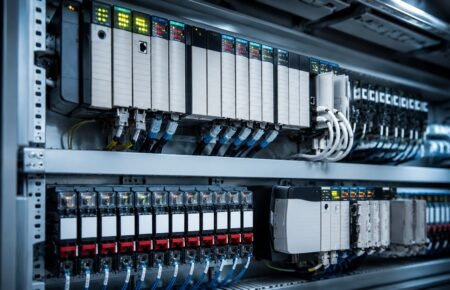
A PLC is like a specialist. It is designed to control specific machines or processes quickly and precisely.
PLCs are commonly used where machines need fast start-stop actions, sensor-based movement or high-speed sorting. In a pharmaceutical packaging line or a chemical bottling plant, for instance, a PLC can control filling, sealing, labelling and sorting with very quick response times.
Its biggest strength is speed. A PLC can respond in 1 to 10 milliseconds, making it useful for mechanical control and machine-level automation.
A DCS, on the other hand, works more like the central brain of a large plant.
It is designed for continuous processes where many variables — such as temperature, pressure, flow and pH — must be monitored and balanced together. In a refinery or a large chemical reactor, a small change in one part of the plant can affect another part of the process. A DCS helps manage these connected operations as one system.
A DCS is usually slower than a PLC, with response times of around 100 to 500 milliseconds. But its strength lies in stability, coordination and plantwide control.
In simple terms, a PLC is better for fast machine-level tasks, while a DCS is better for large, continuous and complex processes.
Why the choice matters in India
In Indian process industries, the decision between DCS and PLC is shaped by the cost of failure.
In a refinery, chemical plant or power facility, an unplanned shutdown is not just a temporary production loss. Restarting operations can take days, and the process may involve safety checks, equipment stress and major financial costs.
That is why industries dealing with continuous production often prefer systems that offer strong redundancy. Redundancy means backup controllers, power supplies and communication systems are built in so that the plant can continue operating even if one part fails.
Refineries: Why DCS fits continuous operations
Indian refineries are going through a major modernisation cycle to meet rising domestic energy demand and support newer fuels.
In December 2022, Honeywell said Regreen Excel EPC India had deployed PlantCruise by Experion DCS solutions across 40 projects in India. These systems were chosen for ethanol and biofuel production, where high availability is important.
A DCS works well in such environments because redundancy is usually built into the system. Controllers, power supplies and communication networks can have backups as part of the standard design.
With PLCs, similar redundancy can be added, but it often requires more custom engineering. This can make the system more complex to design and maintain.
Pharma and biotech: Compliance comes first
For India’s pharmaceutical and biotech industries, the main concern is not only speed. It is compliance, data integrity and quality control.
India is a major supplier to global pharma markets, which means its plants must meet good manufacturing practice standards. Any change in a validated process has to be carefully controlled and documented.
In February 2026, ABB launched its Automation Extended programme in India. This modular DCS solution allows pharmaceutical and biotech firms to upgrade control systems without the long downtime usually associated with major system overhauls.
The advantage of such a system is that it keeps the validated control layer separate from newer digital tools. This means companies can use artificial intelligence for better yields or optimisation, while ensuring that the core production process remains compliant with regulatory requirements.
Power: Managing India’s energy transition
India has set a target of achieving 500 gigawatts of non-fossil fuel-based energy capacity by 2030. According to the Ministry of New and Renewable Energy, India had already reached the point where 50 per cent of its total installed power capacity came from non-fossil sources by early 2026.
This transition needs strong control systems.
Solar and wind power are variable by nature. Their output changes depending on weather, time of day and grid conditions. Managing this alongside battery energy storage systems and traditional thermal power plants requires real-time coordination.
A DCS is better suited to such large-scale control because it can handle hundreds of thousands of input and output points across the system. It also gives operators a single view of the plant or grid environment, helping them maintain stability.
Fragmented PLC networks can work well for smaller systems, but at this scale, they may become harder to manage.
The cost question: Lower upfront cost or lower lifetime cost?
The choice between DCS and PLC is also a financial decision.
A PLC system usually has a lower upfront cost. It is easier to buy, install and use for a single machine or a small process. For a small and medium enterprise in India automating one bottling line, the investment may range from ₹5 lakh to ₹50 lakh, according to Industrial Automation.
A DCS costs much more at the start. For a large plant, the investment can exceed ₹5 crore. But for facilities with more than 2,000 input and output points, a DCS may have a lower total cost over time, according to Industrial Monitor Direct.
The reason is simpler long-term management.
A DCS uses a unified database. If an engineering change is made, it can flow through the system more smoothly. In a PLC-based setup, the same change may need to be programmed separately into many controllers. This increases engineering effort and the risk of human error.
Technical analysis from Sarom Global also suggests that while PLCs are powerful, using them to run a large process plant can create a patchwork of systems that becomes difficult to maintain over a 20-year lifecycle.
The hybrid future
In 2026, the line between DCS and PLC is becoming less rigid.
High-end Programmable Automation Controllers are now gaining some capabilities that were earlier associated mainly with DCS platforms. At the same time, modular DCS systems are becoming more affordable for smaller plants.
This means many plants may not follow a strict “DCS or PLC” model. Instead, they may use a hybrid approach.
A plant may use a DCS for core continuous processes and PLCs for specific machines, packaging lines, utility skids or smaller units. The aim is to choose the right control system for each job.
Cybersecurity is now part of the decision
As control systems become more connected, cybersecurity has become a major operational risk.
Whether a plant uses PLCs, DCS or both, each connected controller can become a possible target if not properly secured. One serious threat is unauthorised code injection, where malicious software changes the logic of a controller.
Indian process industries are increasingly using Zero Trust Architecture. This means every controller, user and device must be verified before getting access.
Manufacturers must also assess the cybersecurity road map of their automation vendors. A control system is no longer just a hardware decision. It is also a digital security decision.
When should a plant choose PLC?
A PLC is usually the better choice when the operation is machine-specific, fast and discrete.
It works well for start-stop logic, packaging lines, bottling lines, material-handling systems, machine tools and utility skids. It is also suitable when the budget is limited and the automation requirement is clearly defined.
For smaller plants or standalone machines, PLCs can offer speed, reliability and cost efficiency.
When should a plant choose DCS?
A DCS is usually the better choice when the process is continuous, complex and safety-critical.
It works well for refineries, chemical plants, large pharmaceutical facilities and power plants where many process variables must be controlled together. It is also better suited when redundancy, long-term stability and a single plantwide view are essential.
For large facilities, the higher upfront cost of a DCS can be justified by easier maintenance, better coordination and lower long-term operational risk.
The bottom line
For Indian process industries, the DCS-versus-PLC decision should not be based only on price. It should be based on the nature of the process, the cost of downtime, safety requirements, compliance needs and long-term maintainability.
PLCs are fast, flexible and cost-effective for machine-level automation. DCS platforms are better suited to large, continuous and complex plants that need coordinated control and built-in redundancy.
As Indian industries modernise, the smartest approach may often be a hybrid one: Use PLCs where speed and machine control matter most, and DCS where stability, safety and plantwide visibility are critical.