





From Inspection to Intelligence: Machine Vision and the Rise of India’s Zero-Defect Auto Sector
For years, car makers’ quality control relied on the age-old tool of industrial production: The human eye. An expert quality inspector would be standing by the production line looking for...

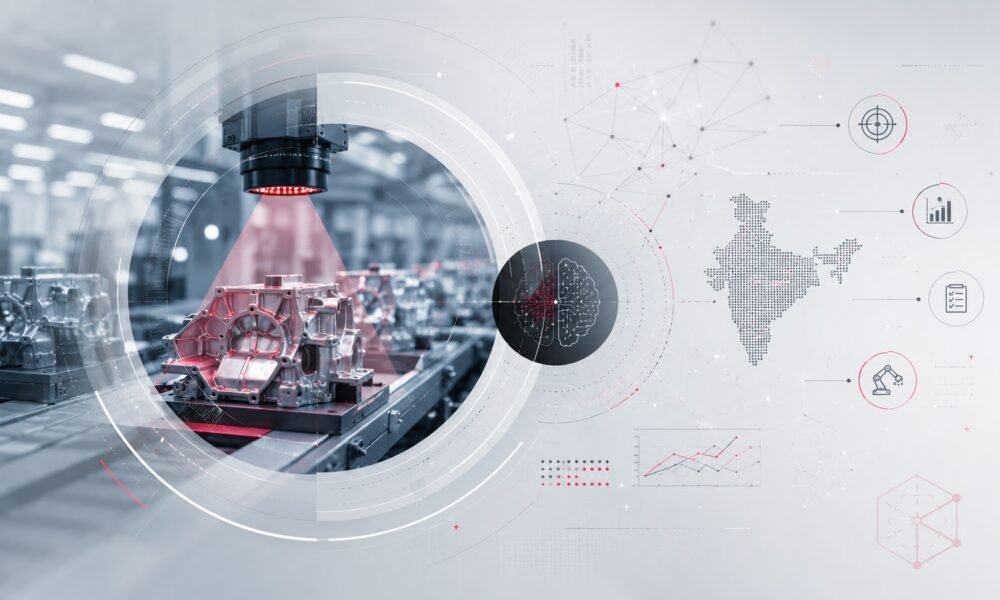
Table Of Content
- Meaning of Zero Defect Has Changed
- Machine Vision Isn’t Just Another Camera
- EV Boom Makes Vision Systems More Important Than Ever
- AI Is Giving Vision Systems Context
- Suppliers have a Big Opportunity
- Quality Is Becoming a Data Problem
- The Skills Challenge Is Growing
- Zero Defect Will Define the Next Manufacturing Decade
For years, car makers’ quality control relied on the age-old tool of industrial production: The human eye. An expert quality inspector would be standing by the production line looking for scratches on painted body panels, checking weld seams for inconsistencies, checking dashboards for alignment, or looking for any minor surface defect before a vehicle rolled out of the factory. Experience mattered. So did concentration. However, no inspectors could be perfect. As the production speeds increased, some defects slipped through due to fatigue, inconsistent lighting, repetitive work, and more.
That model is slowly disappearing these days. In the world’s leading automotive manufacturing plants, quality inspection is no longer just about finding defects, but about avoiding them. Today, thousands of parts are being checked by camera in a single hour, AI algorithms detect minute defects that the human eye cannot, and machine vision systems provide real-time data to production lines to allow production processes to self-correct before defects can accumulate.
Inspection is evolving into intelligence. The shift may be the most significant change in India’s manufacturing history. The next competitive edge for the country will not be just to manufacture more cars because the country is emerging as a global hub for the production of passenger vehicles, electric vehicles, commercial vehicles, two wheelers and their components. It will come at the price of making them with almost no faults.
Meaning of Zero Defect Has Changed
It has been more than a decade since India has been talking about its manufacturing vision “Zero Defect, Zero Effect”. It was a simple thought: create products that are built to meet global standards and reduce pollution. The first step toward zero defects was an improvement in manufacturing discipline. Better training. Better process control. Better quality audits. Better suppliers.
Today Zero Defect Manufacturing is no longer an operational challenge but a technology challenge. Today, in a typical auto manufacturing facility, millions of production data points are generated every day. Every robot movement. Every welding arc. Every paint spray. All torque tightening jobs. Every component assembly. Information collection is not the challenge anymore. The challenge is to be able to interpret it immediately.
Machine vision is transforming the manufacturing process right where it needs to be.
Machine Vision Isn’t Just Another Camera
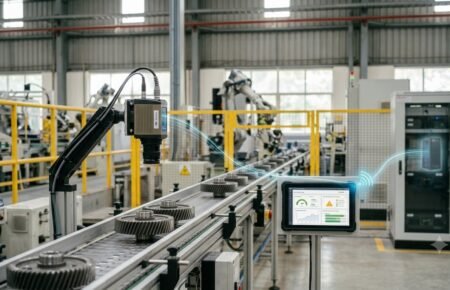
People often think that machine vision is just about putting cameras on the production lines. It’s much more complicated than that. Machine vision is a combination of industrial cameras, specialized lighting, sensors, AI algorithms and computing systems which enable machines to automatically “see,” process and make decisions. These systems do not simply take pictures, but analyze them as they are captured, looking for flaws, measuring dimensions, checking assembly, reading barcodes, directing robots and assuring production quality.
Automotive manufacturing is now able to inspect with machine vision:
- Weld quality
- Paint finish consistency
- Aligning digits so that they are in the same column.
- Surface scratches
- Component presence
- Fastener verification
- Label validation
- Battery assembly
- PCB inspection
- Sealant application
- Tyre markings
- Glass installation
Multiple man inspections can be done in millisecond times.
The Automotive Industry Cannot Rely on Random Inspections Anymore
The days of relying on sampling are over in the automotive industry. Typical quality control systems were based on statistical examination. Inspect one component. Skip the next few. Inspect another. This was successful during relatively small production quantities. Today’s automotive plants go at an amazing pace. Thousands of parts are being transported on production lines every hour.
Failure to replace even one faulty component can result in recall of millions of dollars. The stakes are even greater in the case of electric vehicles. Manufacturing precision is very high for battery modules, thermal management systems, high voltage connectors and electronic control units.
That’s why manufacturers are going to great lengths to inspect each and every component rather than taking random samples. 100% inspection is practically possible with machine vision.
EV Boom Makes Vision Systems More Important Than Ever
The Indian auto industry is riding the crest of a wave of unprecedented technological changes since the liberalization. Electric mobility. Battery manufacturing. Power electronics. Semiconductor integration. Software-defined vehicles. Sophisticated driver assistance technology. Both add to the complexity of manufacturing.
EVs have much more electronics than a mechanical system, which must be inspected on a much smaller scale. A small solder problem on the battery management system. A slight misconnection of a minor connector. An incorrect battery module construction. All of these can have an impact on vehicle performance and safety. Manual checks are not fast enough. Today, vision systems with AI capabilities are becoming more of a necessity than an option.
Inspection Is Becoming Predictive
One of the biggest differences is that machines are not better at finding defects. It’s that they are more and more anticipating and avoiding defects. Traditional inspection asks: “Does this part fail to perform its function?”
Nowadays, the question of modern machine vision is: Why is this defect occurring? Over the years, AI can detect hidden process variations by looking at thousands of production images. Perhaps one of the welding robots is just beginning to go off center.
Perhaps one injection mold is starting to get worn out. Perhaps one paint nozzle needs to be cleaned. Rather than discarding bad products, manufacturers fix the process. Quality shifts upstream. This is where inspection is intelligence.
AI Is Giving Vision Systems Context
The traditional machine vision relied on predefined rules. If the scratch length is beyond a certain limit, it is to be rejected. Failure to have any of the bolts will result in a failure in inspection. Generate alarm if colour is out of tolerance. That’s all AI takes care of.
Deep learning enables vision systems to identify intricate defect patterns without having to program all of the possible scenarios. Thousands of production images are used as the system’s teachers. It slowly separates good variations from real quality problems. This is particularly useful in automotive production where surfaces, textures and lighting constantly vary.
Today, vision systems with modern AI technology can often reach detection accuracy levels that are as high as or higher than manual inspections, and can perform the task 24/7 for consistent accuracy.
The biggest opportunity for India is in the supplier.The largest opportunity in India is the Supplier.
Suppliers have a Big Opportunity
Thousands of MSMEs produce castings and forgings, plastic parts, wiring harnesses, electronics, seats, dashboards, lighting systems and precision parts. These suppliers are more and more engaged as global OEM’s.
The entire world expects the world’s quality. Machine vision can give small manufacturers a competitive edge. Affordable AI cameras. Edge computing. Cloud analytics. Low-code inspection software. The technologies are helping lower the barriers to machine vision adoption for use in large factories. This can turn into a productivity leveler for the supplier ecosystem in India.
Quality Is Becoming a Data Problem
Future automotive plants will create more than vehicles. They will generate data. Each inspection image becomes part of a large collection of digital data. The data then becomes meaningful for:
- Manufacturing Execution Systems (MES)
- Digital twins
- Predictive maintenance platforms
- Process optimization software
- Quality analytics based on artificial intelligence
Manufacturers will have a large database of knowledge related to quality. Patterns will be identified. Repetitive defects will be eliminated. The quality of suppliers will be improved. Engineering decisions will be made based on evidence rather
The Skills Challenge Is Growing
Future automotive plants will create more than vehicles. They will generate tons of data. Each inspection image becomes part of a large collection of digital data. The data then becomes meaningful for:
- Manufacturing Execution Systems (MES)
- Digital twins
- Predictive maintenance platforms
- Process optimization software
- Quality analytics based on artificial intelligence
Manufacturers will have a large database of knowledge related to quality. Patterns will be identified. Repetitive defects will be eliminated. Future defects predicted. The quality of suppliers will go up as well as a result.
Zero Defect Will Define the Next Manufacturing Decade
Technology is insufficient to achieve zero-defect manufacturing Engineers in India are needed with the ability to combine:
- Automation.
- Artificial Intelligence.
- Industrial optics.
- Data science.
- Robotics.
- Manufacturing engineering.
Implementing machine vision calls for special skills from different disciplines established scarcely ever together. Universities, technical colleges, and training will have to review their educational systems in the field of manufacturing.
Tomorrow, a quality engineer may spend much time developing AI led tech programs instead of just using evaluation devices.
Price is an impediment, however, not for long, historically speaking, the implementation of machine vision was pricey with cost of:
- Industrial cameras.
- Control systems.
- Artificial Intelligence software.
- Integration.
- Support.
As a result, many small companies could not adopt this technology.
Luckily, the situation is changing with Narrow AI processors. Open-source platforms. More affordable industrial cameras. Cloud analytics and innovative Business models based on machine vision.