







AMRs vs AGVs in Indian Warehouses: Which Automated Material Handling Solution Delivers Better ROI?
India’s warehouse automation market is moving into a high-growth phase. It is projected to reach $659.96 million in 2026 and grow at an annual rate of 17.84 per cent by […]

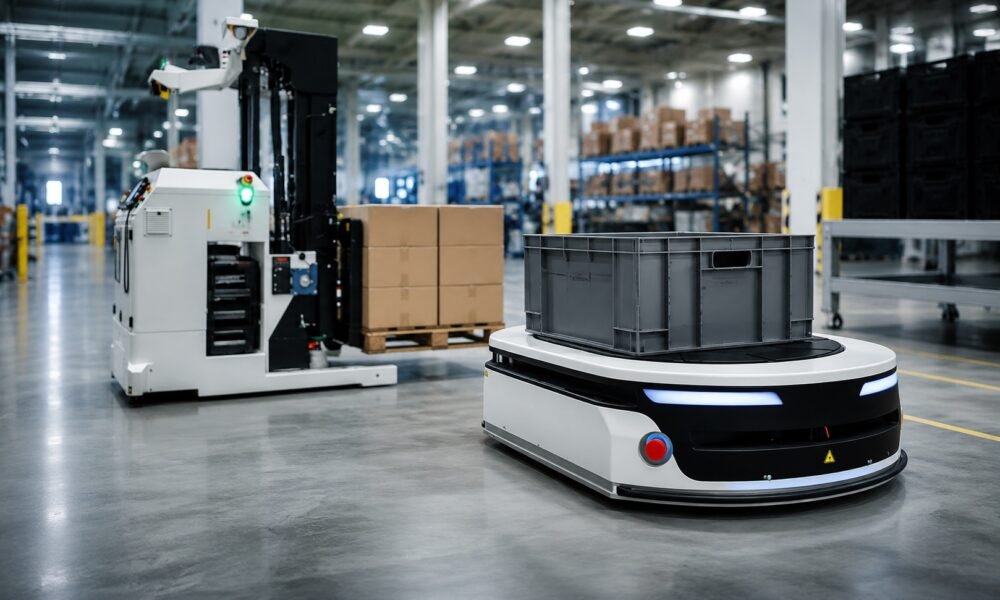
Table Of Content
- Technical difference: Fixed routes vs flexible movement
- The Botsync innovation: Heavy-duty performance
- India’s changing warehousing economy
- Looking beyond the purchase price
- Challenges in brownfield warehouses
- How ROI works in the Indian market
- Fleet management and scalability
- The future: Automation as the new standard
- Emerging drivers and specialised use cases
- The shift to automation-as-a-service
India’s warehouse automation market is moving into a high-growth phase. It is projected to reach $659.96 million in 2026 and grow at an annual rate of 17.84 per cent by 2031, according to Mordor Intelligence. As e-commerce and quick-commerce companies push delivery timelines towards 10-30 minutes, traditional block-stack warehouses are giving way to more technology-led fulfilment hubs.
The choice between automated guided vehicles (AGVs) and autonomous mobile robots (AMRs) has become a key decision for logistics managers looking for better return on investment (ROI).
Technical difference: Fixed routes vs flexible movement
Both AGVs and AMRs automate the horizontal movement of goods inside warehouses. However, they work very differently.
AGVs follow fixed paths. They usually depend on physical guides such as magnetic tape, wires or QR codes to move through a facility. This makes them reliable for stable and repetitive processes. However, they also require significant infrastructure changes and are difficult to modify once installed.
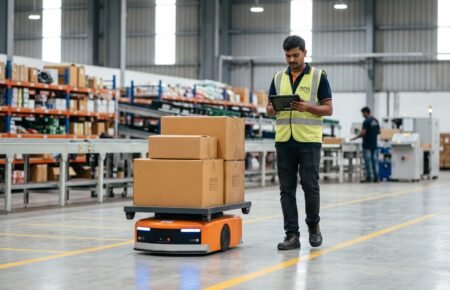
AMRs, on the other hand, are designed for dynamic movement. They use advanced sensors, light detection and ranging, and simultaneous localisation and mapping to navigate through a facility. They can detect and move around obstacles in real time without wires, floor markings or fixed routes. This makes them better suited to warehouses where layouts and workflows change frequently.
The Botsync innovation: Heavy-duty performance
Indian startup Botsync is addressing the needs of heavy industry through its MAG series of robots.
Its heavy-duty solutions, such as the MAG1500, offer a payload capacity of 1,500 kg, which is far higher than standard light-duty sorting bots. These robots are used for tasks such as automated pallet handling, stacking and inter-stage material transfer in automotive and manufacturing facilities.
A key advantage is that Botsync’s AMRs use visual navigation, allowing them to be deployed quickly in brownfield facilities with minimal downtime.
India’s changing warehousing economy
India’s warehousing sector is no longer limited to facilities on the outskirts of Tier-I cities. After the rollout of the goods and services tax and the National Logistics Policy, the sector has moved from fragmented godowns to large-scale, Grade-A fulfilment centres. This shift has increased demand for faster and more efficient material handling.
The pressure is especially visible in e-commerce and quick commerce. Ten-minute delivery models require warehouses to move from daily batch processing to continuous, real-time operations. Human-only picking and sorting systems are finding it difficult to keep pace with the thousands of stock-keeping units that need to be processed every hour.
The labour market is also undergoing a shift. While India has long benefited from relatively low labour costs, logistics companies are now dealing with high attrition and a shortage of skilled operators for specialised machinery. Automation helps bridge this gap by ensuring round-the-clock operational continuity.
Looking beyond the purchase price
For Indian logistics firms, return on investment cannot be judged only by the initial purchase price. The total cost of ownership is more important.
AGVs often have lower upfront hardware costs because their navigation systems are simpler. But installing magnetic strips or under-floor wiring across a 100,000-square-foot facility can be expensive. AMRs usually cost more per unit, but they require little or no infrastructure change. This often makes their total deployment cost lower.
Downtime is another important factor. AGVs may stop working if floor markings are damaged, blocked or difficult to read. But AMRs can identify obstacles and reroute themselves, maintaining higher uptime. This can help protect revenue in a competitive logistics market.
Energy efficiency also affects the cost. Modern AMRs are equipped with advanced power-management systems. They can charge during low-demand periods and remain available when operations peak — reducing the need for large charging areas often needed for traditional AGVs powered by lead-acid batteries.
Challenges in brownfield warehouses
Many Indian warehouses are brownfield sites, which means they were not originally built for robotics.
Floor quality is a major challenge. Older warehouses may have uneven flooring or high dust levels, which can affect the optical sensors used by standard robots. Companies such as Botsync address this through ruggedised suspensions and advanced filtering of LiDAR data.
Integration with legacy systems is another challenge. Robots need to work seamlessly with existing warehouse-management systems and enterprise resource planning software. Modern autonomous mobile robot fleets increasingly come with open application programming interfaces, making data exchange easier. This also supports smart slotting, where artificial intelligence identifies the most efficient storage location based on order frequency.
How ROI works in the Indian market
For an Indian logistics company, the return-on-investment calculation usually includes several factors.
First, there are labour savings. Replacing manual pallet jacks with a single 1,000-kg AMR can reduce dependence on workers across 2-3 shifts.
Second, automated systems can reduce safety-related costs. Fewer accidents inside warehouses can lower insurance costs and compensation claims.
Third, AMRs can improve space utilisation. Since they can move through narrower aisles than traditional forklifts, warehouses may be able to increase storage density by 20-30 per cent.
Fourth, automation can reduce errors. Picking accuracy of 99.9 per cent can lower the costs linked to returns and reverse logistics.
Fleet management and scalability
Operating one robot is relatively simple. Managing a fleet of 50 robots requires a strong fleet-management system.
Modern fleet-management systems work like air traffic control. They prevent bottlenecks at narrow intersections and ensure robots are sent to areas where the workload is highest.
They also use predictive analytics to track the health of each robot. This allows maintenance to be scheduled before a component fails. Moving from reactive maintenance to predictive maintenance can extend the life of the investment and reduce unplanned downtime.
The future: Automation as the new standard
By 2027, autonomous material handling may become standard in Grade-A warehouses across India. 5G connectivity and edge artificial intelligence could make autonomous mobile robots more capable and cost-efficient. While 5G can support a large number of connected devices, edge AI allows robots to process more information where it is generated.
AGVs will continue to be useful in highly structured and static environments, such as dedicated production lines in automotive assembly. However, the unpredictable and fast-moving nature of Indian e-commerce makes AMRs better suited to many modern warehouses.
For companies such as Botsync, the opportunity lies in combining heavy-duty load capacity with the intelligence required for modern logistics.
India’s warehouse automation market is also projected to reach $2.84 billion by 2034, according to OpenPR. As the market expands, smart logistics is becoming a national priority.
Emerging drivers and specialised use cases
E-commerce remains a major growth driver, but warehouse automation is now expanding into other sectors as well.
Pharmaceutical and healthcare logistics are expected to lead future growth, with a compound annual growth rate of 26.8 per cent through 2031, according to the Mordor report. This is being driven by demand for temperature-controlled automated storage and traceable inventory retrieval.
Tier-II and Tier-III cities are also creating new demand. Smaller fulfilment centres need modular, drop-in automation systems that can be deployed without the long buildout required by traditional infrastructure.
The shift to automation-as-a-service
High upfront capital expenditure remains a challenge for small and medium enterprises. To address this, automation financing and “X-as-a-Service” models are becoming more common.
Managed service providers now offer phased implementation plans, allowing companies to scale robotic fleets in line with seasonal demand. Startups like Unbox Robotics, which was reported to have secured $28 million in early 2026, reflect the growing interest in this space.
In the AMR-versus-AGV debate, the right answer depends on the needs of each facility. However, for modern warehouses dealing with high stock-keeping unit churn, changing layouts and fast delivery expectations, AMRs are likely to deliver stronger long-term return on investment.