






Building Resilient Industrial Networks for the Connected Factory
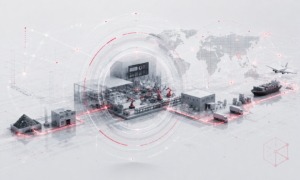
Next Manufacturing Advantage Will Depend Less on Machines and More on the Networks That Connect Them A decade ago, conversations around factory automation revolved around robots, PLCs, sensors and...
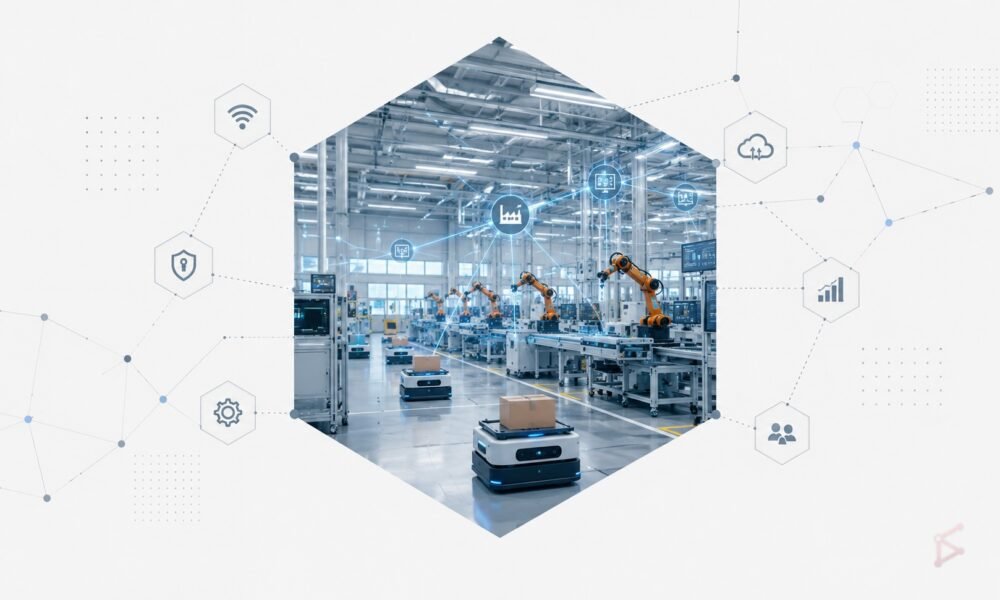
Table Of Content
- Next Manufacturing Advantage Will Depend Less on Machines and More on the Networks That Connect Them
- From Automation to Intelligence
- IT and OT Are Finally Becoming One Conversation
- Visibility Is Becoming More Valuable Than Connectivity
- AI Needs Better Networks Before It Needs Better Algorithms
- The Technologies Quietly Reshaping Factory Connectivity
- India’s Next Competitive Advantage May Be Invisible
Next Manufacturing Advantage Will Depend Less on Machines and More on the Networks That Connect Them
A decade ago, conversations around factory automation revolved around robots, PLCs, sensors and production lines. Today, those conversations sound very different. Manufacturers are talking about Industrial AI, digital twins, and edge intelligence. Yet beneath all these technologies lies something that rarely receives the same attention as the industrial network.
While possibly not as eye-catching as a robotic arm or as thrilling as an AI-driven vision system, it has subtly emerged as one of the most strategic investments in today’s manufacturing. All connected robots, AI models, vision cameras, sensors, controllers and digital twins rely on a network that can deliver secure, reliable and real-time data movement. This change is gaining significance in India more than ever.
In Gujarat, Tamil Nadu, Karnataka, Maharashtra and Telangana and in Uttar Pradesh, new manufacturing plants are being established as part of the Make in India initiative, Production Linked Incentive (PLI) schemes and India Semiconductor Mission, respectively. Automotive OEMs are ramping up EV production; electronics manufacturers are scaling up smartphone and semiconductor ecosystems; pharmaceutical companies are investing in digitally connected plants; and global capability centres (GCCs) are beginning to assume increased responsibility for industrial engineering, artificial intelligence (AI) and factory operations.
In nearly all of these investments, automation is just a tool to the task.
From Automation to Intelligence
The time of industrial automation has come of a new era. The focus of automation for decades has been on machine control. Programmed instructions were carried out by PLCs, operations were monitored by SCADA systems and Distributed Control Systems (DCS) were used to ensure production stability. The factory of today is quite different. Robots work cooperatively with human humans. Machine vision systems check thousands of pieces of product per hour!
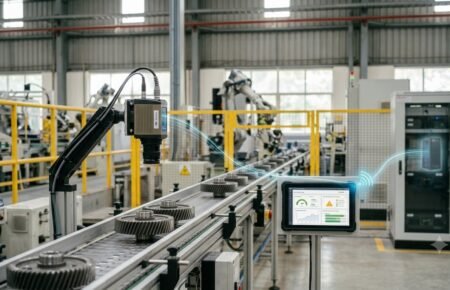
AI anticipates equipment failures and warns before they happen. Digital twins are used to simulate production changes before they are implemented by the engineer. Edge Computing allows real-time analytics at the factory floor. These capabilities are changing manufacturing, and they have all got one thing in common; they all require high quality data that must be captured continuously. Even the most advanced AI can be just another standalone app if there’s no industrial communication. That is why automation companies around the world are increasingly focused on investments other than controllers and robotics – investment in networking, cybersecurity and industrial software.
India’s Smart Factory Ambition Needs Smarter Networks
The nation desires to be a top global destination for electronics production, semiconductor packaging, automotive manufacturing, pharmaceutical production, renewable energy equipment and advanced engineering. There is growing reliance on connected production in these sectors. Consider an electric vehicle plant. Hundreds of robots and automated guided vehicles, vision systems, torque tools, battery assembly lines and quality inspection stations require data to be exchanged every second. Or, a pharmaceutical plant.
Production batches, environmental monitoring systems, MES platforms, quality records and laboratory systems have to communicate seamlessly and comply with strict requirements. AI optical inspection machinery produces vast amounts of image information in the electronics manufacturing process, which can’t be processed without slowing down production. All the following operations cannot be done without the help of machines. They are successful because information flows perpetually throughout the factory. That’s why industrial networking is gaining traction as a vital element of automation.
IT and OT Are Finally Becoming One Conversation
The rise of convergence between Information Technology (IT) and Operational Technology (OT) is one of the largest transformations taking place within manufacturing. Both teams worked without any cooperation for years. Managed business systems, enterprise applications and cybersecurity. OT paid attention to maintaining production. That’s a division that has been wiped away by Industry 4.0.
ERP systems, Cloud analytics, MES platforms, AI applications and Digital engineering environments are key challenges for today’s production decisions. Production data is being sent from the sensor to the boardroom. This convergence presents huge possibilities, but also immense complexity. Legacy applications now share the space with cloud-native applications. Robots “talk” to AI models at edge. Production systems are directly linked with suppliers and customers. The challenge now is not just to enable connectivity. It is helping to facilitate trusted connectivity.
Visibility Is Becoming More Valuable Than Connectivity
A majority of factories already have networks. Much less do they truly grasp them. It is very difficult for many manufacturers to identify all assets connected within their facilities. Over the years, switches, obsolete PLCs, unmanaged devices and forgotten engineering workstations may get left connected to production networks.
This visibility problem goes beyond maintenance. It impacts cybersecurity, compliance, troubleshooting and future digital transformation. Complete asset discovery is the starting point for managing a modern industrial network.
Cybersecurity Has Moved to the Factory Floor
Cyber security may be the most obvious example of how industrial networking has become more significant as a function.Cyber security is an obvious example of how this networking function is becoming more important. Cyberattacks are no longer considered an IT incident. They consider them production dangers. If there is a problem with the controller, production can be halted. A ransomware attack will stop shipments. A remote processing connection that is vulnerable can impact worker safety. Cyber resilience is increasingly becoming Operational resilience.
AI Needs Better Networks Before It Needs Better Algorithms
Artificial Intelligence is the principal theme in all manufacturing conversations these days. However, AI can only be as useful as the data it is powered by. Incomplete datasets are the result of a lack of network performance. The later the communication is delayed, the less accurate the prediction will be. When systems are not connected, enterprise-wide learning is not possible. Oftentimes, manufacturers spend substantial resources on acquiring AI without considering the digital infrastructure that supports it.
This is seldom an effective strategy. Predictive maintenance is an ongoing sensor data process. Machine vision requires low-latency communication. Digital twins need synchronized operational information. Reliability, contextual and secure connectivity are all critical for industrial AI. In many scenarios it is the network, rather than the algorithm that is the constraint.
The Technologies Quietly Reshaping Factory Connectivity
There are multiple technologies that are supporting manufacturers to make their digital infrastructure more resilient. Industrial Ethernet is going to take the place of proprietary communication systems using faster, more interoperable architectures. OPC UA offers a common interface to exchange information in multi-vendor scenarios.
MQTT makes it easy to communicate securely in the industrial IoT. Time Sensitive Networking (TSN) allows for deterministic Ethernet for robotics and motion control. Private 5G enables greater flexibility for private autonomous mobile robots (AMRs), AGVs and large manufacturing campuses. Edge Computing decreases latency by processing operational data near the production. With Software-Defined Networking, policies can be centrally managed across multiple facilities.
The nation is welcoming foreign investments in advanced manufacturing, clean energy, pharmaceuticals, automotive, semiconductors and electronics. AI goes from pilots to production. For industry, the key to automation is to increasingly shift from hardware to software. More operational data is being produced in factories than ever before.
India’s Next Competitive Advantage May Be Invisible
In the next wave of factory competitiveness, it will not be so much about the number of robots a plant will have, but about how well they can communicate with one another, with machines, with sensors and with software platforms.
The role of industrial networks has been shifting gradually from the communication backbone to strategic business infrastructure and has largely gone unnoticed. Now they are the ones that define cybersecurity resilience, AI readiness, operational visibility, production flexibility and finally business competitiveness.
That’s a significant mindset change for Indian manufacturers. Not all the smartest factories will be the most automated. It will be the one that’s best positioned to possess the most resilient digital base and make the best use of all of the technologies on top of it, all while ensuring secure networks, trusted data and intelligent connectivity work in perfect harmony. In the connected factory, competitive advantage is not solely based on machines. It’s created from the unseen connections that fuel their continuous improvement, communication, and thinking.