




Top Industry 5.0 companies in India
Here are leading Industry 5.0 companies in India, enabling human-centric manufacturing through collaborative robotics, automation and smart factory solutions Indian manufacturing is moving beyond...

Table Of Content
- Why Industry 5.0 matters for Indian industry
- How to choose the right Industry 5.0 solution
- Industry 5.0 companies in India you should know about
- Festo
- Siemens
- Stäubli
- Bosch Rexroth
- ABB
- Universal Robots
- KUKA
- Key trends shaping this market
- Frequently asked questions
- 1. What is Industry 5.0?
- 2. How is Industry 5.0 different from Industry 4.0?
- 3. Which industries benefit most from human-centric manufacturing?
- 4. Are Industry 5.0 companies in India suitable for mid-sized manufacturers?
- 5. What technologies enable Industry 5.0?
Here are leading Industry 5.0 companies in India, enabling human-centric manufacturing through collaborative robotics, automation and smart factory solutions
Indian manufacturing is moving beyond traditional automation goals centred only on speed and efficiency. While Industry 4.0 focused heavily on connectivity, data and machine intelligence, Industry 5.0 introduces a broader vision: one that places human expertise alongside advanced automation. This shift is shaping interest in Industry 5.0 companies in India, particularly among manufacturers seeking more resilient, flexible and worker-friendly production systems.
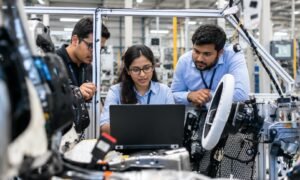
Industry 5.0 emphasises collaboration between people and machines rather than complete automation. Technologies such as collaborative robotics, intelligent sensors, machine vision, industrial software and artificial intelligence help workers perform higher-value tasks while improving safety, productivity and quality. This approach is especially relevant in India, where labour-intensive production, customised manufacturing and export-oriented sectors often require a balance between automation and workforce adaptability.
As smart factories evolve, human-centric manufacturing is becoming increasingly important for businesses aiming to improve operational performance without removing human decision-making from the production environment.
Why Industry 5.0 matters for Indian industry
Industry 5.0 offers practical benefits for Indian manufacturers dealing with changing market demands, rising quality expectations and labour productivity pressures.
Many industrial sectors now require greater flexibility. Automotive suppliers, electronics manufacturers, pharmaceuticals and precision engineering companies increasingly handle shorter production runs and more customised output. Human-machine collaboration supports this shift by combining robotic precision with human judgement.
Safety is another major factor. Collaborative systems can reduce worker exposure to repetitive or hazardous tasks while preserving human oversight in quality inspection and decision-making.
Industry 5.0 also supports resilience. Supply chain disruptions and labour shortages have highlighted the need for adaptable production environments. Human-centric systems allow manufacturers to reconfigure operations more quickly.
From a competitiveness standpoint, Industry 5.0 aligns with digital transformation goals by improving productivity while preserving workforce value. This balance is becoming especially relevant in India’s manufacturing ecosystem.
How to choose the right Industry 5.0 solution
Selecting human-centric manufacturing solutions in India requires careful assessment of both technical and operational needs.
Integration capability is essential. New systems should work with existing automation infrastructure, including programmable logic controller (PLC) systems, supervisory control and data acquisition (SCADA) systems and manufacturing execution software.
Safety standards deserve close attention. Collaborative robots and intelligent automation systems must support safe human-machine interaction within plant environments.
Ease of programming is another important criterion. Many Indian manufacturers prefer systems that allow rapid deployment without requiring highly specialised robotics expertise.
Scalability also matters. Solutions should support future expansion across multiple production lines or facilities.
After-sales service and local engineering support are particularly important. Human-centric manufacturing systems often require training, calibration and workflow optimisation after installation.
Finally, buyers should evaluate the total cost of ownership, including maintenance, software updates, training and integration costs.
Industry 5.0 companies in India you should know about
Festo
Festo is known for industrial automation, pneumatic systems and motion control technologies.
Festo supports Industry 5.0 through automation systems designed to improve ergonomic workflows and collaborative operations. Its solutions are often considered in assembly automation and advanced manufacturing environments.
Industrial users should assess system compatibility with existing automation architecture and long-term maintenance requirements.
Siemens
Siemens offers a broad industrial portfolio covering automation, digital twins, software and industrial communication.
Siemens is relevant for organisations pursuing large-scale smart factory transformation. Its digital tools help integrate operational technology, analytics and human decision support into production systems.
For Indian manufacturers, implementation complexity and integration planning are important considerations, especially in multi-site deployments.
Stäubli
Stäubli specialises in industrial robotics, connectors and automation systems for precision manufacturing.
Its robotic solutions are commonly considered in sectors requiring high accuracy, such as electronics, pharmaceuticals and cleanroom operations. Stäubli supports human-centric workflows through precise robotic assistance in specialised tasks.
Buyers should assess application suitability, precision requirements and service availability.
Bosch Rexroth
Bosch Rexroth provides drive and control technologies, motion systems and factory automation solutions.
The company supports Industry 5.0 by enabling modular production systems and flexible automation architectures. Its technologies are relevant for manufacturers modernising assembly and motion control processes.
Indian buyers should evaluate interoperability with existing hardware and software systems before investment.
ABB
ABB is widely recognised for robotics, motion technologies and industrial automation systems.
ABB’s collaborative and intelligent robotic systems support safer production environments and improved process consistency. Industries such as automotive, electronics and logistics frequently consider ABB for advanced automation.
Buyers should carefully assess integration requirements, particularly when combining robotics with legacy production systems.
Universal Robots
Universal Robots is widely known for collaborative robots, often called cobots, designed to work safely alongside human operators. Its robotic arms are used for assembly, packaging, inspection and machine tending.
Universal Robots is especially relevant for small and mid-sized manufacturers adopting flexible automation without fully redesigning production lines. Cobots support human-centric manufacturing by automating repetitive tasks while allowing workers to focus on complex operations.
Indian buyers should assess payload requirements, workflow design and integration complexity before deployment.
KUKA
KUKA is known for industrial robotics and intelligent manufacturing automation.
KUKA serves industrial users requiring robotic precision, flexible production and advanced automation workflows. Its robotics portfolio supports applications ranging from material handling to assembly.
For manufacturers exploring Industry 5.0, KUKA is relevant where robotic collaboration and workflow adaptability are priorities. Deployment planning and workforce training remain important considerations.
Key trends shaping this market
Several trends are accelerating the adoption of Industry 5.0 in India.
Collaborative robotics is becoming more accessible, allowing even mid-sized manufacturers to automate repetitive tasks while retaining human oversight. This is reducing barriers to entry for flexible automation.
Artificial intelligence is also improving human-machine collaboration. Vision systems and analytics increasingly assist operators in quality inspection, anomaly detection and process optimisation.
Digital twins are gaining traction in advanced manufacturing. These virtual models help simulate production changes before deployment, reducing implementation risk.
Industrial Internet of Things adoption continues to expand as connected sensors provide real-time production insights. This improves traceability, predictive maintenance and decision support.
Mass customisation is another driver. Manufacturers increasingly require production systems that handle product variation without sacrificing efficiency.
Sustainability is also influencing Industry 5.0 strategies. Human-centric production often aligns with resource optimisation, reduced waste and smarter energy usage.
Industry 5.0 represents an important shift in industrial strategy, particularly for manufacturers seeking to balance automation with workforce value. Rather than replacing people, human-centric manufacturing focuses on combining human judgement with robotic precision and digital intelligence.
The right solution depends on use case, plant maturity, integration needs, budget and service support. Buyers should prioritise interoperability, safety, scalability and workforce readiness when evaluating vendors.
For Indian manufacturers, Industry 5.0 offers a practical path towards more flexible, resilient and intelligent production systems that improve both operational performance and workforce productivity.
Frequently asked questions
1. What is Industry 5.0?
Industry 5.0 focuses on collaboration between humans and intelligent machines to improve flexibility, safety and productivity.
2. How is Industry 5.0 different from Industry 4.0?
Industry 4.0 emphasised connectivity and automation, while Industry 5.0 adds human-centric collaboration and resilience.
3. Which industries benefit most from human-centric manufacturing?
Automotive, electronics, pharmaceuticals, logistics and precision engineering commonly benefit from such systems.
4. Are Industry 5.0 companies in India suitable for mid-sized manufacturers?
Yes. Many vendors now offer scalable collaborative automation suitable for mid-sized industrial operations.
5. What technologies enable Industry 5.0?
Collaborative robots, artificial intelligence, machine vision, sensors, industrial software and connected automation systems are key enablers.