








Rethinking Warehouse Design: How Quick Commerce and Dark Stores are Driving India’s $2.8B Automation Boom
The 10-minute delivery shockwave on warehouse layouts Given how quick-commerce companies are promising 10-minute grocery deliveries in cities like Mumbai, Bengaluru or Delhi-NCR, the traditional...

Table Of Content
- The 10-minute delivery shockwave on warehouse layouts
- Micro-fulfilment centres versus traditional mega-warehouses
- Smart cart strategies for local shop floor conditions
- Low-cost modular upgrades for business owners
- Linking the app directly to the shelves with smart WMS
- Decoding dark store economics and real financial payback
- Tackling the crowded streets of Tier 2 and Tier 3 cities
The 10-minute delivery shockwave on warehouse layouts
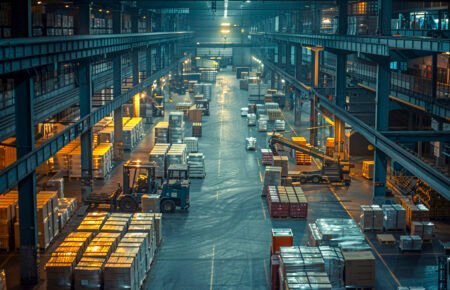
Given how quick-commerce companies are promising 10-minute grocery deliveries in cities like Mumbai, Bengaluru or Delhi-NCR, the traditional warehouse design understanding has been turned upside down. A standard warehouse was a giant, dusty building on the outskirts where workers had hours to pack one single order.
Now the warehouse has to be sitting right inside the neighbourhood of the delivery address. This has given birth to the ‘dark store’: a small, hyper-local mini-warehouse. Because real estate inside premium city centers is incredibly costly, these dark stores cannot afford to waste any floor space. Layouts have thus shifted toward narrow aisles and high vertical shelving, making space optimisation critical to business survival.
Micro-fulfilment centres versus traditional mega-warehouses
The big architectural change in the logistics market being seen is the rise of the ‘micro-fulfilment centre’ (MFC) overshadowing the traditional mega-warehouse. Where the traditional warehouse was like a slow, massive railway freight train holding a huge amount of stock but taking days to move things to the end customer, an MFC is a high-speed delivery bike, very fast and furious.
MFCs are tiny, automated setups packed tightly into small urban spaces, taking up just 3,000-5,000 square feet. Instead of workers walking through aisles, automated storage and retrieval systems are bringing the product bin directly to the packing station. This is cutting the ‘click-to-ship’ packing time from 45 minutes to 60 seconds, explaining how the delivery app is assigning a rider before your even finishing locking your smartphone screen.
Smart cart strategies for local shop floor conditions
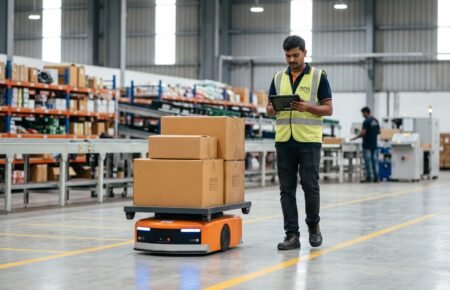
When global automation companies were first bringing high-end ‘Autonomous Mobile Robots’ (AMRs) and ‘Automated Guided Vehicles’ (AGVs) to India, many initial trials were seen failing on the floor. Because Western warehouses are usually leveled, glossy concrete floors where robots can glide smoothly without any tension.
But a typical Indian dark store is like a converted commercial basement where the floors are full of dust and uneven, having sudden bumps. To handle these conditions, logistics leaders started deploying rugged, high-clearance AMRs equipped with advanced sensors. Instead of completely replacing human workers with expensive robotic arms that cost too much money, the smart strategy in India is becoming ‘co-botics’: affordable smart carts navigating the bumpy aisles for assisting workers, allowing the picker to stand in one spot and pack items at triple the speed without getting tired or taking a tea break.
Low-cost modular upgrades for business owners
For cost-conscious small and medium enterprises (SMEs) expanding in Tier 2 and Tier 3 cities like Patna, Indore or Jaipur, spending 20 crore rupees on a fully robotic warehouse is creating a massive financial headache. The way forward for Indian businesses is adopting a modular automation strategy.
Instead of buying a robotic ecosystem all at once, they should be upgrading their setup step-by-step. Start by replacing manual clipboards with a smart Warehouse Management System (WMS) app and wireless barcode scanners. Later, when order volumes are seen rising and business is booming, owners can think of adding a modular conveyor belt or a digital ‘pick-to-light’ flashing system on the shelves. This system is paperless, light-guided by placing LEDs on storage racks or bins for directing warehouse workers to the delivery. This phased approach allows smaller distributors to use advanced electronic tracking and zero-error sorting without massive upfront capital investment.
Linking the app directly to the shelves with smart WMS
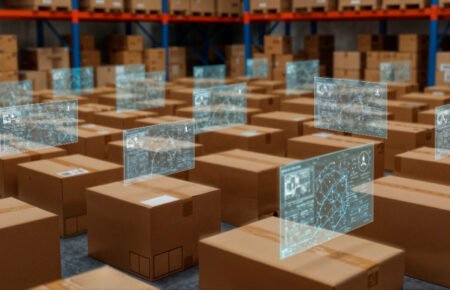
The real brain driving this system is integrating between front-end e-commerce applications and back-end WMS. Earlier, inventory counts were updating manually at the end of the day, leading to annoying situations wherein a customer ordering an item online was getting a cancellation call later because the shelf was actually empty.
Today, as a customer is tapping ‘add to cart’ on the smartphone, the cloud-based WMS is cross-checking the stock level in the nearest neighbourhood dark store. The system is automatically planning the most efficient picking route for the floor staff, ensuring that high-demand items like fresh milk, bread and eggs are placed adjacent to the packing counter.
Decoding dark store economics and real financial payback
Quick commerce is a game of razor-thin margins and running an urban dark store creates financial stress unless the return on investment (ROI) is clear. The good news is that by deploying targeted, low-cost modular automation, a dark store can be seeing a complete payback within 12-18 months.
The financial math is straightforward: automation allows a single dark store to handle 3 times the number of daily orders without expanding physical footprint or doubling staff count. By keeping inventory accuracy near-perfect, the store is removing the risk of stock expiration and material wastage, turning a high-risk urban experiment into a predictable, profitable and cashflow-generating engine for the business owners.
Tackling the crowded streets of Tier 2 and Tier 3 cities
However, the trend of 10-minute grocery delivery is no longer just a metropolitan city phenomenon. Quick commerce giants are setting up dark stores in rapidly growing regional centers like Patna, Jaipur, Lucknow and Indore. But scaling into these locations is bringing a completely different set of structural challenges. Unlike the well-mapped, wide layouts of a Delhi tech park, regional markets are packed with narrow lane networks, heavy rickshaw traffic and sudden power cuts.
Because of this local environment, companies are not relying on massive, power-heavy sorting systems. Instead, regional hubs are deploying hyper-localised, battery-backed micro-fulfilment modules. The layout inside a Patna dark store is being intentionally designed around local buying habits, placing high-demand seasonal items right next to the packing counter.
Furthermore, instead of relying on expensive mobile data connections that would easily be dropping signals inside basement stores, operators are using low-power Bluetooth grids and offline-capable hand terminals. This smart approach is ensuring that the floor staff can scan, pack and hand over a delivery bag to a motorcycle rider in less than 2 minutes, keeping the quick-commerce system fast, uniform and reliable anywhere in the country.