








Automated Storage and Retrieval Systems in India: How they are changing e-commerce fulfilment
India’s e-commerce warehouses are changing fast. As online shopping, quick commerce and next-day delivery grow, companies can no longer depend only on manual picking, sorting and storage. Warehouses...

Table Of Content
India’s e-commerce warehouses are changing fast. As online shopping, quick commerce and next-day delivery grow, companies can no longer depend only on manual picking, sorting and storage.
Warehouses now need to store more products, process more orders and deliver faster — often from spaces located close to cities, where land is expensive. This is where Automated Storage and Retrieval Systems, or ASRS, are becoming important.
ASRS helps warehouses store and retrieve goods automatically. Instead of workers walking long distances to pick items from shelves, machines bring the right product to the right place at the right time. For e-commerce and logistics companies, this can improve speed, reduce errors and make better use of limited warehouse space.
India’s e-commerce market is projected to reach about $163 billion by 2026, according to India Brand Equity Foundation. This growth is putting pressure on older warehouse models, where space constraints, human error and slow picking can lead to delivery delays and higher costs.
What ASRS does inside a warehouse
ASRS is designed to solve two common warehouse problems: limited space and slow retrieval.
In large cities such as Mumbai, Bengaluru and Delhi, warehouse rentals are high and suitable land is limited. ASRS allows companies to use vertical space more effectively. Instead of spreading inventory across a large floor area, goods can be stored in tall racks and retrieved by automated cranes, shuttles or rotating systems.
This is especially useful for high-volume businesses that must process orders quickly without expanding their physical footprint.
The main types of ASRS
The right ASRS depends on what a warehouse stores and how fast goods need to move. In India, three common types are unit-load systems, mini-load systems and carousel systems, according to Addverb.
Unit-load ASRS is used for heavy palletised inventory, usually weighing between 500 kg and 1,500 kg. These systems use large stacker cranes to move pallets across tall storage racks, which can go up to 40 metres in height. They are useful for sectors such as fast-moving consumer goods, where companies need to store large volumes within limited space.
Mini-load ASRS is used for smaller items stored in totes, bins or cartons, usually weighing under 100 kg. This works well for e-commerce warehouses, where companies handle thousands of stock keeping units and need frequent picking.
Carousel systems are another option, especially for small parts. These systems use rotating bins that bring items to a fixed picking station. This reduces walking time for workers and keeps frequently used products within easy reach.
Why the economics are changing
The case for ASRS in India is becoming stronger because both land and labour are under pressure.
In major logistics hubs, warehouse rentals have been rising due to high demand for grade-A spaces. According to Colliers, average rentals in prominent logistics clusters rose by 5-10 per cent during 2025 as demand outpaced supply in busy micro-markets.
This makes vertical storage more valuable. If a warehouse can store more goods in the same space, it can delay or avoid the need to lease additional area.
ASRS also improves accuracy. In e-commerce, even a small picking error can lead to returns, customer complaints and reverse logistics costs. Automated systems help reduce these mistakes by ensuring that the right item is picked and sent for packing.
The initial investment is high, but high-throughput facilities can often justify the cost through faster fulfilment and better accuracy. Industry analysis cited by Addverb indicates that ASRS can reduce fulfilment time by around 50 per cent.
How ASRS works with warehouse software and robots
The real strength of ASRS comes when it is connected with other warehouse systems.
A warehouse management system, or WMS, acts as the control centre. It decides where items should be stored, which products should be retrieved first and how goods should move through the facility.
For example, fast-moving items can be placed in easier-to-access locations, while slower-moving stock can be stored in denser areas. This helps improve speed and space use.
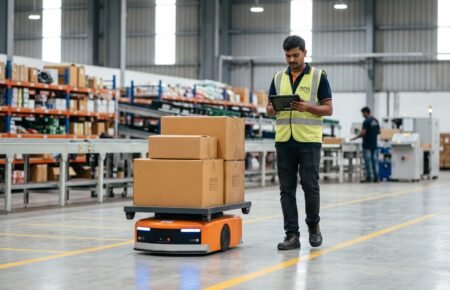
ASRS can also work with autonomous mobile robots, or AMRs. In this setup, ASRS handles high-density storage, while AMRs move goods from retrieval points to packing stations.
This is more flexible than fixed conveyor systems. If order demand rises in one section of the warehouse, AMRs can be redirected quickly without changing the physical layout.
Companies such as Addverb and Jidoka Technologies are deploying such integrated solutions in India. These systems are helping third-party logistics providers handle more than 1,000 picks per hour during peak festive seasons.
Why contactless operations matter
The Covid-19 pandemic pushed many warehouses to reduce unnecessary human contact with products. That trend continues to shape warehouse design.
ASRS supports more controlled and contact-light operations. This is useful in sectors such as pharmaceuticals and perishable food, where product handling, hygiene and traceability are important.
The same technology is also supporting micro-fulfilment centres and dark stores. These are smaller, automated hubs located closer to residential areas. They help companies process orders quickly and support delivery timelines of under 30 minutes.
What comes next
ASRS adoption is expected to grow further as India’s logistics infrastructure improves.
The Production Linked Incentive schemes and the Gati Shakti master plan are expected to support broader automation by improving manufacturing capacity, connectivity and supply-chain efficiency. As hardware costs fall and Indian-made robotic solutions become more advanced, smaller companies may also begin adopting modular ASRS systems.
This means ASRS will not remain limited to large e-commerce players or global logistics firms. Over time, smaller warehouses may also use these systems in phases, starting with one section or process before expanding further.
The road ahead
ASRS is changing e-commerce fulfilment in India by addressing three major challenges: space, labour and accuracy.
It allows warehouses to store more in less space, reduce manual errors and speed up order processing. For businesses dealing with high order volumes and tight delivery timelines, this can make a clear operational difference.
The upfront cost remains significant. However, the long-term benefits can be strong. According to a Sellers Commerce report, ASRS can reduce operating expenditure by an estimated 42 per cent over 5 years.
For India’s digital-first economy, automated storage is no longer just a futuristic upgrade. It is becoming a practical way to build faster, denser and more reliable supply chains.