








Automated Quality Control – Eliminating Defects at Industrial Scale
For years, manufacturers quietly accepted the reality that defects would happen. Even in the most disciplined production environments, a small percentage of flawed products would inevitably slip...

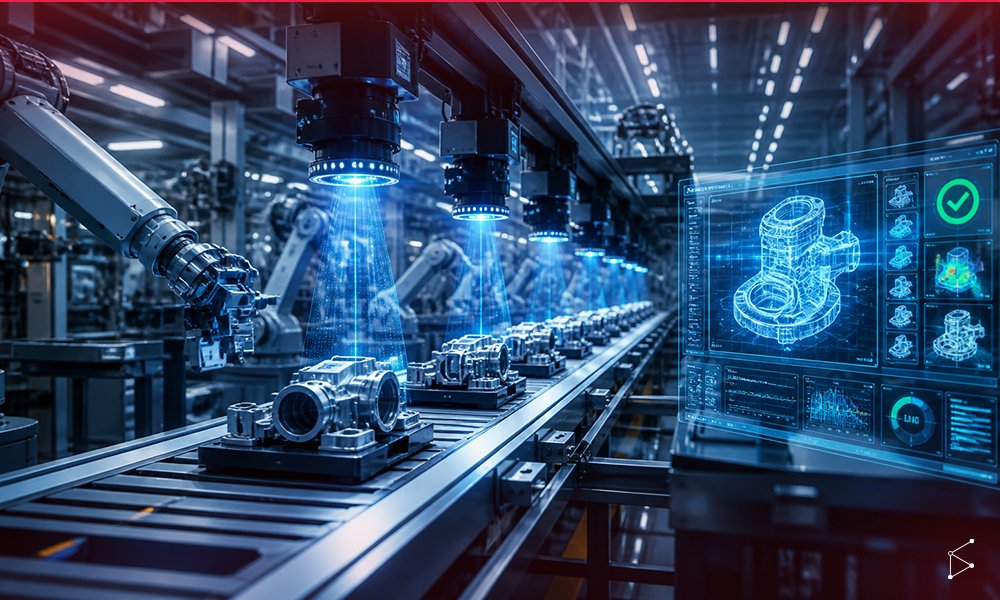
Table Of Content
For years, manufacturers quietly accepted the reality that defects would happen. Even in the most disciplined production environments, a small percentage of flawed products would inevitably slip through. Quality teams worked very hard to minimise such errors, but manual inspection and sampling methods meant that some imperfections were unavoidable. As a result, manufacturers built “acceptable defect rates” directly into their operational models.
In the modern manufacturing arena, that assumption is becoming increasingly difficult to defend. Production lines are faster, product tolerances are tighter, and customers expect near-perfect reliability. A single defective component can lead to warranty claims, regulatory complications, or reputational damage that outweighs the cost of the product itself.
As manufacturing complexity grows, companies are realising that traditional inspection methods are no longer sufficient. Automated quality control systems are emerging as an important solution, allowing manufacturers to detect defects earlier, reduce wastage and maintain consistent product standards at scale.
The Limits of Manual Inspection
Quality inspection has traditionally depended on trained human inspectors monitoring products as they move through the production line. Skilled operators may detect many types of defects, particularly those related to surface appearance or assembly alignment.
However, human inspection has natural limitations.
Production lines often run for long hours at high speeds, requiring inspectors to observe thousands of nearly identical components. Over time, fatigue becomes unavoidable.
So, their concentration levels fluctuate, and subtle defects slip through unnoticed. Even the most experienced inspectors cannot maintain perfect focus throughout every shift.
This challenge becomes even more pronounced in modern manufacturing environments where microscopic tolerances matter. Tiny surface scratches, minor dimensional deviations, or subtle assembly errors can have significant downstream consequences.
As production volumes increase, relying solely on human inspection introduces a level of variability that manufacturers can no longer afford.
The Risk Behind Statistical Sampling
To address the limitations of manual inspection, many manufacturers adopted statistical sampling.
Instead of examining every item produced, quality teams would inspect a small portion of each batch. If the sample met quality standards, the entire batch was considered acceptable.
While this method improves efficiency, it introduces a fundamental risk: sampling does not guarantee that every product meets the required standard. Defective items can still move through the production process undetected.
In high-stakes industries, such as automotive, electronics, pharmaceuticals, or aerospace, even a small defect finding its way to the market can lead to serious consequences. Product recalls, compliance penalties and loss of customer trust can create financial and reputational damage that far exceeds the cost of inspection.
As a result, manufacturers are increasingly looking for ways to move beyond sampling and towards full-line monitoring.
The Rise of Automated Inspection Systems
Automated quality control replaces periodic inspection with continuous monitoring.
Modern inspection systems combine high-resolution cameras, amazing lighting setups and machine learning algorithms to analyse products as they move through the production line. These systems capture detailed images of each item and compare them against predefined quality parameters in real time.
In contrast with manual inspection or sampling, automated systems can inspect every single unit produced.
For instance, computer vision systems used in electronics manufacturing can detect misaligned components, solder defects or surface irregularities in milliseconds. In automotive production, automated inspection systems can identify paint imperfections or assembly inconsistencies before vehicles progress further along the assembly line.
When a defect is detected successfully, the system flags the item and removes it from the production stream before it reaches packaging or shipment.
This shift from selective inspection to full-line monitoring remarkably reduces the likelihood of defective products reaching customers.
Seeing What Humans Cannot
One of the most powerful advantages of automated quality control is that it goes beyond human vision capabilities.
Advanced inspection systems incorporate multiple sensing technologies to detect structural issues that might not be visible externally.
Thermal imaging identifies uneven heat distribution in welded joints, signalling weak structural bonds. X-ray inspection systems detect internal fractures or hidden voids within components. Acoustic sensors can analyse sound patterns in rotating equipment to identify internal mechanical issues.
These technologies allow manufacturers to evaluate the external appearance of a product along with its internal structural integrity.
For industries where reliability and safety are crucial, this level of inspection dramatically reduces the risk of field failures.
From Defect Detection to Process Improvement
Automated quality control does more than simply remove defective products from the production line. It also generates valuable data about the manufacturing process itself.
Because every product is inspected, automated systems produce detailed records of when and where defects occur. This data helps manufacturers identify patterns that might otherwise go unnoticed.
For instance, if inspection systems consistently detect dimensional errors in stamped components, the issue may point to tooling wear or alignment problems in the equipment. By identifying these patterns early, production teams can adjust machinery before large numbers of defective products are produced.
Over time, this creates a continuous feedback loop that improves manufacturing processes and reduces defect rates across the entire operation.
Instead of reacting to quality problems after they occur, manufacturers gain the ability to prevent them.
Raising the Standards for Manufacturing Quality
Automated quality control is not just the representation of a technological upgrade. It also reflects a shift in manufacturers’ approach to product reliability.
As production volumes increase and tolerances become tighter, traditional inspection methods struggle to keep pace with the demands of modern manufacturing. Automated systems provide the speed, consistency and analytical capability required to maintain high quality standards across complex production environments.
More importantly, automation does not eliminate the role of human expertise. Instead, it frees skilled operators from repetitive inspection tasks and allows them to focus more on improving production processes and solving complex operational challenges.
In a manufacturing landscape where precision and reliability are tantamount to competitive advantage, the concept of an “acceptable defect rate” is rapidly becoming outdated.
The factories setting the pace at present are those embedding automated inspection directly into their production systems. They are ensuring that defects are detected early, processes improve continuously and every product leaving the line meets the highest possible standards.