






Danfoss Adds ICFL 20 Valve for More Precise Industrial Refrigeration Control
Danfoss has now refined its offering of industrial refrigeration with the new ICFL 20, a motor operated expansion valve that offers greater accuracy of refrigerant control in applications where...

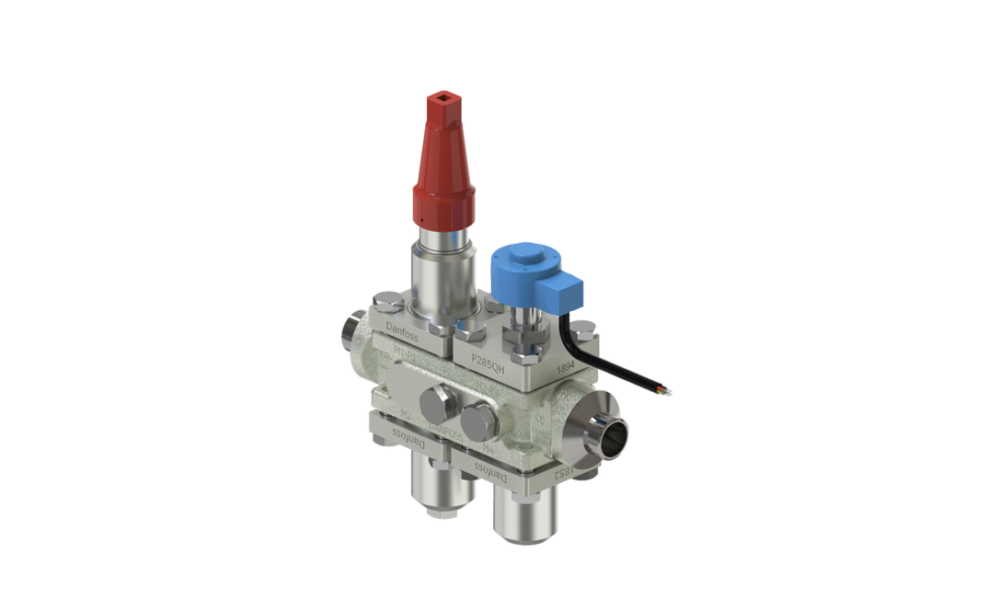
Danfoss has now refined its offering of industrial refrigeration with the new ICFL 20, a motor operated expansion valve that offers greater accuracy of refrigerant control in applications where stability of temperature and evaporator performance are critical.
The new valve is for use in pumped recirculated refrigeration systems and wet direct expansion (WDX) systems, specifically for ammonia and CO₂ applications. The ICFL 20 is designed to regulate refrigerant flow to provide more consistent response for refrigeration systems during start-up, load change and other transient conditions.
The ICFL 20 is essentially a valve which is controlled via a stepper-motor for accurate expansion control. Danfoss describes the ICFL 20 as a WDX electric expansion module, which can be installed on the modular ICF valve station instead of a separate valve arrangement. (Danfoss Assets)
The modular approach becomes crucial for industrial refrigeration operators. ICF valve stations integrate several refrigeration tasks into a single valve body, thereby minimizing the complexity of installation and ease of servicing/modifying. (Danfoss)
Additionally, the ICFL 20 is a single valve solution or a function module in an ICF valve station, offering greater flexibility to contractors and OEM’s to design new applications or upgrade current installations.
The valve is used in conjunction with the EKE 100 driver and EKE450 controller for NeoCharge ammonia expansion applications, with the EKE 100 driver performing the signal conversion between the controller and motorised valve. The separation of actuator and driver can also help make wiring, commissioning and servicing easier.
The ICFL 20’s overall benefit is to make more accurate electronic refrigerant control a reality for industrial systems. Electronically controlled valves are increasingly playing a critical role in modern refrigeration architectures as the operators seek more stable temperature control, energy performance and control given the different load conditions.
That combination of precise flow control with modular integration can help to optimize system performance and simplify future upgrades in facilities like cold stores, food processing plants and other industrial refrigeration applications.