







Industrial Robots in India: How Articulated Robots and Cobots Are Reshaping Automotive, Electronics and Pharma Manufacturing
Industrial robots are becoming a serious part of India’s manufacturing story. As the Make in India push gathers pace, factories are under pressure to produce more, improve quality and reduce...

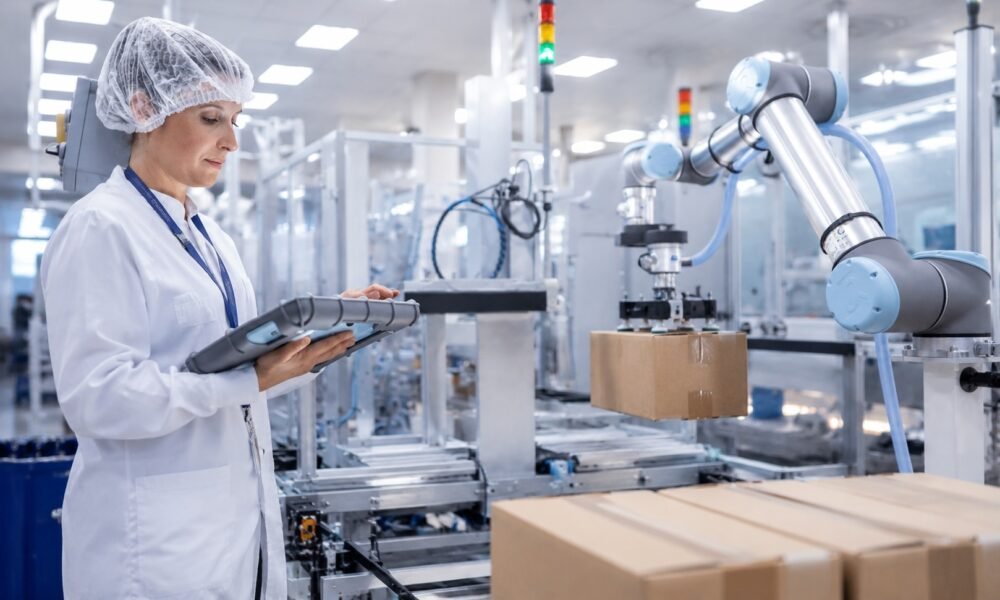
Table Of Content
Industrial robots are becoming a serious part of India’s manufacturing story.
As the Make in India push gathers pace, factories are under pressure to produce more, improve quality and reduce errors. Robotics is no longer just a high-end advantage for large companies. In many sectors, it is becoming necessary to stay competitive.
India’s industrial robotics market was valued at about $1.62 billion in 2024 and is projected to reach $3.45 billion by 2030, expanding at a compound annual growth rate of 13.1 per cent, according to Grand View Research.
The pace of adoption is already visible. India installed a record 9,100 industrial robots in 2024, a 7 per cent increase from the previous year, according to the World Robotics 2025 report. India is now the sixth-largest installer of industrial robots globally and has an operational stock of more than 52,500 robots, according to robolabs.ai.
Why articulated robots dominate heavy manufacturing
Articulated robots remain the backbone of industrial automation in India. These are the large robotic arms commonly seen in automotive factories. They have multiple joints, which allow them to move with a wide range of motion.
They are especially useful for high-precision work such as welding, painting, assembly and material handling.
According to a 2026 report from robolabs.ai, articulated robots hold a 39 per cent share of India’s industrial robotics market. The automotive sector remains the biggest user, accounting for about 45 per cent of all robot installations in the country.
This is not surprising. Modern vehicle assembly is complex, and manufacturers need consistent quality at high speed. Robots help reduce variation, improve precision and support large-scale production.
The International Federation of Robotics reported in May 2023 that India’s robot density in the automotive industry reached 148 robots per 10,000 employees in 2021. Global companies such as FANUC and ABB are key players in this space, providing robotic systems for high-volume production lines.
Cobots are making automation more accessible
While large articulated robots dominate heavy manufacturing, collaborative robots, or cobots, are opening up automation for smaller factories.
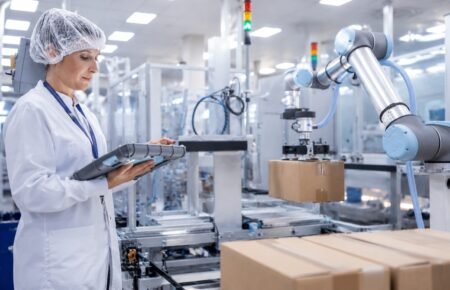
Cobots are designed to work alongside human operators. Unlike traditional industrial robots, they usually need less safety fencing and can be easier to deploy in compact workspaces.
This makes them useful for small and medium enterprises, especially in electronics, pharmaceuticals and component manufacturing.
Cobot prices have also become more competitive. This has made them more attractive for companies that cannot afford large robotic cells or do not have specialised robotics teams.
Modern cobots are easier to install and programme. Many come with simplified interfaces, allowing workers to guide them through tasks without complex coding.
The “up to 5 kg” payload segment accounts for nearly 44 per cent of the market, according to Grand View Research. This makes cobots suitable for tasks such as printed circuit board handling, small-part assembly and drug packaging.
North India, especially Delhi-National Capital Region industrial hubs, accounts for 32 per cent of robot demand, according to robolabs.ai. This demand is being driven by automotive component suppliers and electronics firms.
AI is making robots smarter
The next big shift is the integration of artificial intelligence and machine learning.
Earlier, robots mainly followed fixed instructions. Now, more systems can learn from data, adjust to changing conditions and detect problems before they become serious.
In maintenance, AI-powered systems can analyse machine data and predict failures before they happen. This helps reduce unplanned downtime and maintenance costs.
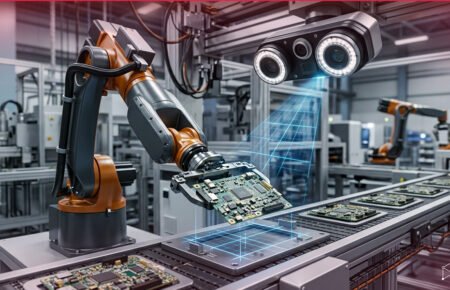
In electronics manufacturing, AI-led visual inspection is becoming common. High-speed cameras can spot tiny defects in real time, often more accurately than human inspectors.
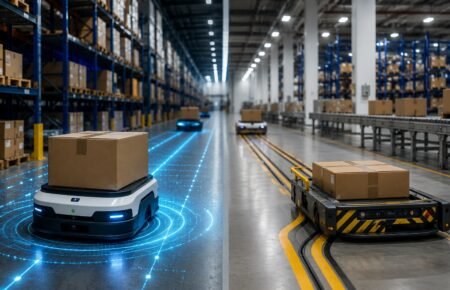
In warehouses, Indian companies such as Addverb Technologies and GreyOrange are using fleets of mobile robots that can work together, divide tasks and adjust to changing floor layouts. This is especially useful in e-commerce and quick-commerce operations, where order volumes and product mixes change rapidly.
How govt support is driving adoption
India’s robotics growth is closely linked to the Production Linked Incentive (PLI) scheme.
With an outlay of ₹1.91 lakh crore, the PLI scheme has encouraged investment across 14 strategic sectors, including advanced automotive technology and electronics. These incentives are pushing manufacturers to upgrade older systems and meet global quality standards.
By 2025, the scheme had helped reduce mobile phone imports by 77 per cent, as domestic production expanded to meet 99 per cent of internal demand, according to a 2026 release from the Ministry of Commerce and Industry.
Another important step is the Electronics Component Manufacturing Scheme, notified on April 8, 2025, with an outlay of ₹22,919 crore. The scheme is expected to support domestic production of components such as multi-layer printed circuit boards and camera modules.
These policy measures are helping India build a stronger local ecosystem for electronics and robotics-led manufacturing.
The automation gap is still large
Despite record robot installations, India still has a long way to go.
The country’s overall robot density was reported to be around 30 per 10,000 employees in April 2026 — far below South Korea, with 1,220 per 10,000 employees and Germany (449).
This shows that India still has a major automation gap.
To close it, manufacturers will need to address several challenges.
Many brownfield factories need upgrades before they can support modern robotic cells. The country also needs more engineers and technicians who understand both robotics and AI-led analytics.
Cybersecurity is another growing concern. As industrial robots become connected through the Industrial Internet of Things, factories must follow standards such as IEC 62443 to protect systems from cyber risks.
Investment momentum is improving. Expected investment commitments under schemes such as the Electronics Component Manufacturing Scheme had reached ₹1,15,351 crore by December 2025, according to a Government of India release in February 2026.
Logistics and warehousing emerge as growth areas
Automotive manufacturing remains the biggest user of industrial robots, but logistics and warehousing are now growing quickly.
The boom in e-commerce and quick commerce in cities such as Bengaluru and Mumbai has increased demand for autonomous mobile robots. These robots help move goods inside warehouses, reduce manual handling and improve order fulfilment speed.
Indian companies such as Addverb Technologies and GreyOrange are also exporting warehouse robots to global markets. This shows that Make in India is not only about serving domestic demand. It is also helping India build specialised robotics products for the world.
The road to 2030
India has set an ambitious target of reaching 1 million operational robots by 2030. To get there, the industry will need new business models as well as new technology.
One such model is Automation-as-a-Service. Instead of buying expensive robotic systems outright, smaller companies can lease robotic cells and pay based on use. This reduces upfront capital pressure and makes automation more accessible.
The shift also links with India’s broader clean-energy and electric mobility push. As automated manufacturing expands alongside electric vehicle and component production, India has an opportunity to build a more efficient and sustainable industrial base.
The bigger picture
Industrial robots in India have moved beyond novelty. They are now becoming central to productivity, quality and global competitiveness.
Articulated robots are strengthening heavy manufacturing, especially in automotive plants. Cobots are making automation more practical for smaller factories. AI is helping robots become smarter, while govt incentives are encouraging companies to invest in modern production systems.
The next phase will not be judged only by how many robots India installs. It will depend on how well those robots are integrated, how much local capability India builds, and whether smaller manufacturers can also benefit from automation.
For Indian manufacturing, robotics is no longer just about replacing manual work. It is about building factories that are faster, safer, more consistent and better prepared for global supply chains.