







Webinar Summary | Breaking the Manufacturing Data Silos
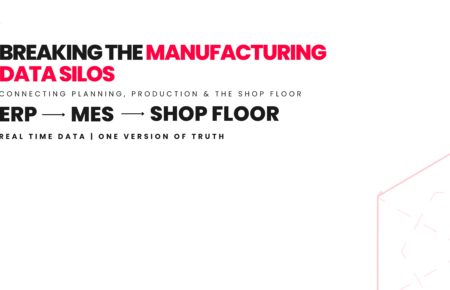
Breaking the Manufacturing Data Silos Most manufacturers already have the data they need. The problem is that it does not move. That was the central argument of our latest webinar […]

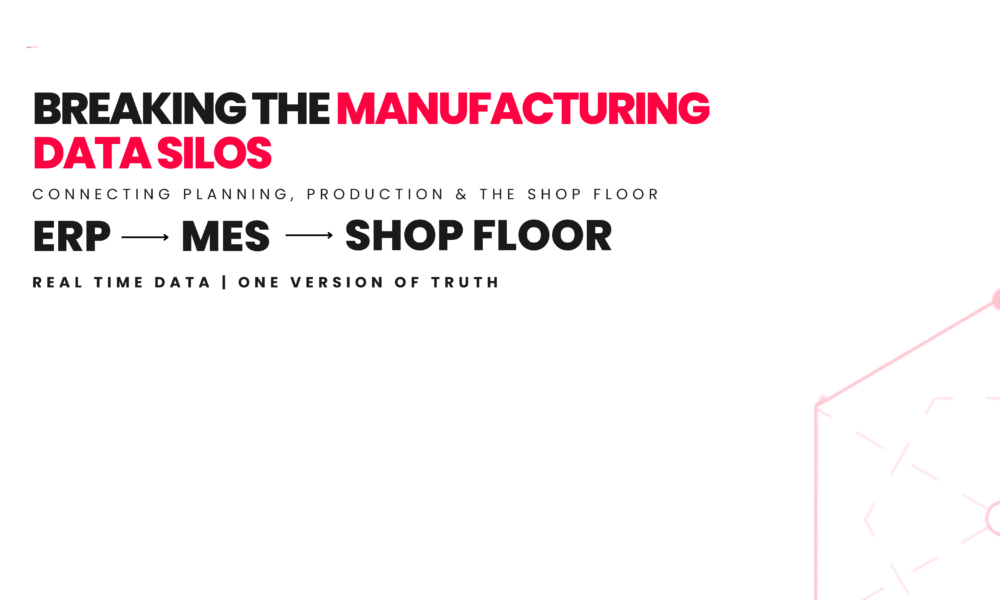
Breaking the Manufacturing Data Silos
Most manufacturers already have the data they need. The problem is that it does not move. That was the central argument of our latest webinar with Kumar Mallampalli, Partner and Co-founder of RheinBrücke IT Consulting and co-founder of the manufacturing-focused e-procurement platform Merlin. An IIT Madras graduate with more than 30 years across automotive, airline and engineering IT, Kumar grounded the discussion in practice.
What a silo actually is
Information will always travel between sales, planning, production, procurement and the finished goods yard. It becomes a silo, Kumar said, when that movement depends on someone emailing a spreadsheet or carrying a physical record, rather than flowing on its own in real time.
Companies usually notice only when customers complain about missed deliveries, margins trail competitors, or growth stalls despite a healthy business. The causes are structural: machines, lines and plants get added without upgrading the information architecture, or acquisitions bring in new locations. Informal communication that worked at small scale breaks down as the business grows.
The connected enterprise
Using the industrial automation pyramid as reference, from sensors and PLCs through SCADA and MES to ERP, Kumar defined a connected operation as one where information moves both ways across every layer. A machine outage travels up fast enough to act on; a large new order travels down just as quickly.
Replacing legacy equipment is not a prerequisite. Older machines can be fitted with non-invasive sensors, though he advised an expert assessment first to establish whether full or partial coverage is achievable.
He also drew a sharp line between connected operations and more reporting. Dashboards are post facto. A connected plant enables dynamic rescheduling, paperless operations, predictive maintenance and real-time quality checks, with potential gains of up to 30% in equipment utilisation and up to 50% reduction in plant-level downtime.
Proof points
Two deployments illustrated the scale of the gains. At a large food manufacturing and cloud kitchen operation handling more than 300,000 orders, order consolidation fell from 32 hours to one. At a major auto parts supplier, a fully paperless warehouse now updates the ERP with a single barcode scan, reorders automatically at safety stock levels, and has cut weekly stock inspection from 40 hours to 13 seconds.
Where silos hurt differently
In engineer-to-order environments, the risk lies between design and the shop floor: an engineering change that fails to propagate means the floor builds the old version, leading to rework and delays. In pharma, the priorities are first-in, first-out handling of expiring materials, validation at every stage, and audit-ready proof that the process itself is sound.
The fastest return, he said, comes from synchronising planning, inventory and manufacturing to cut wastage, then tighter shop floor monitoring to reduce downtime.
How to start, and why projects stall
Attempting everything at once inflates budgets until projects are deferred, and triggers stakeholder resistance. Kumar’s recommended sequence runs from shop floor automation to SCADA, then an MES connected to both the floor and a manufacturing-grade ERP, rolled out location by location.
Ownership sits with leadership. Projects stall without an executive sponsor, a single empowered programme owner, and the advance commitment of plant managers, IT heads and other key stakeholders.
AI on the shop floor, with guardrails
Kumar described a live edge AI deployment at one of India’s largest battery manufacturers, where cameras and microphones inspect output in real time and flag defects without stopping the line, pushing quality beyond what sampling allows. The same approach is being used to detect early signs of machine failure.
He set out three preconditions for AI in manufacturing: data sovereignty through private, ring-fenced infrastructure; governance over who sees what; and security against external threats. His advice for the next two to three years was to invest in foundational technology with measurable impact, resist adopting AI for its own sake, and begin the shift from automated to autonomous manufacturing.
From the audience
The Q&A covered familiar friction points. Misaligned production and maintenance schedules are a process gap to fix before systems. Operators resist new tools when they add data entry, so the goal is to eliminate it. Stock mismatches call for a warehouse management system integrated with the ERP, within a composable architecture. Slow pharma change control needs its bottleneck identified, since technology cannot replace approval authority. Non-technical promoters respond to use cases tied to cash flow, profitability and growth. And an MES, rather than direct shop floor-to-ERP links, spares teams the burden of maintaining custom connectors.
Key takeaways
- A silo exists wherever data moves by email, spreadsheet or paper instead of in real time.
- Legacy machines can be connected; assess feasibility before spending.
- Reports explain the past; connected systems let plants act in the moment.
- Build in phases, backed by an executive sponsor and one accountable owner.
- Adopt AI where the gains are measurable, and settle sovereignty, governance and security first.
Thanks to Kumar and to our lovely audience- everyone who joined and brought sharp questions to the discussion.
The full recording will shortly be available on the website and our YouTube channel.