






Regal Rexnord and FANUC Team Up to Simplify Collaborative Robot Deployment
The production line is increasingly becoming a space of collaboration between robots and people, and as this trend continues today’s manufacturers have a need for solutions that are deployed...


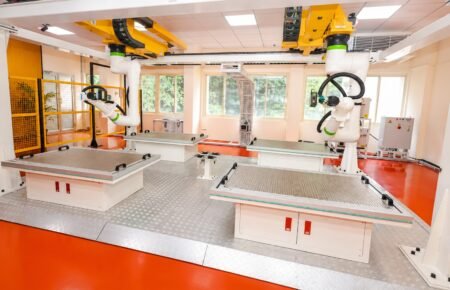
The production line is increasingly becoming a space of collaboration between robots and people, and as this trend continues today’s manufacturers have a need for solutions that are deployed quickly, with minimal integration requirements. Regal Rexnord’s new partnership with FANUC fulfills this need by providing a pre-integrated motion solution that enhances the capabilities of collaborative robots and streamlines collaborative robot installation.
The collaboration integrates technologies from various Regal Rexnord brands such as Thomson linear motion systems, Boston Gear gearheads, Huco couplings, and Kollmorgen motors and software with the FANUC CRX collaborative robots. The key to the solution is the Thomson Movotrak™ Cobot Transfer Unit (CTU) that allows cobots to move along a linear axis, extending their working range while using a smaller sized robot.
After compatibility testing, the Movotrak CTU is seamlessly connected to the FANUC Cobot Device ecosystem by a software interface. This enables certified FANUC system integrators to set up and run the linear axis directly from the robot teach pendant, reducing engineering time and accelerating deployment. In addition to the extended reach, the integrated solution also enables more advanced functions like coordinated motion and collision detection, enabling robots to operate safely with persons in the same area in situations where they must cover larger areas or multiple stations.
The partnership is part of a broader move towards fuller, plug-and-play automation solutions from vendors, as industrial automation becomes increasingly more comprehensive. Manufacturers are looking for solutions to integrate robots, motion systems and control software from multiple vendors into the same application, but these integrations can be time-consuming and carry additional deployment risk, which is why a validated solution is preferred to save time in commissioning applications and risk in deployment.
The partnerships between the companies and the collaborative robots underscore the need for an integrated automation platform that is easy to deploy, flexible to scale and can provide faster production without adding complexity. As collaborative robots start becoming more common in various areas of the automotive, electronics, logistics and general manufacturing industry, this collaboration is just one example of the increased demand for such platforms.