








Can India move towards lights-out manufacturing?
Lights-out manufacturing means a factory, or part of a factory, can run with little or no human intervention. The idea may sound futuristic, but it is slowly becoming more realistic […]

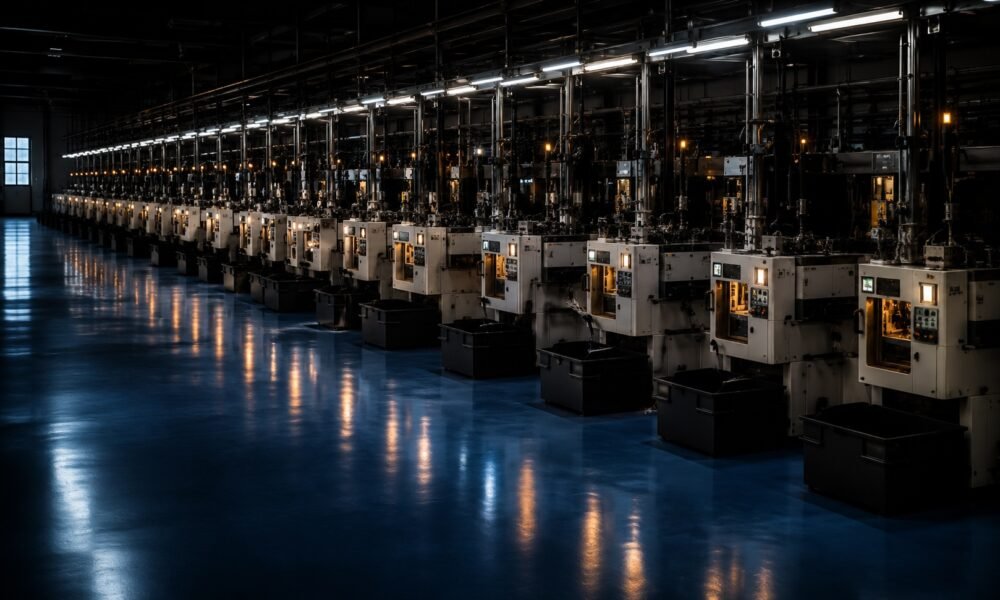
Table Of Content
- Phase 1: Start with data, not robots
- Phase 2: Use automation to manage production better
- Phase 3: Move towards selective lights-out production
- Where India is already seeing progress
- The economics of automation
- Workers will need to move into new roles
- The barriers are real
- A practical road map for Manufacturers
- The road ahead
Lights-out manufacturing means a factory, or part of a factory, can run with little or no human intervention. The idea may sound futuristic, but it is slowly becoming more realistic for Indian manufacturers.
A mix of cheaper automation tools, rising night-shift labour challenges and growing innovation in industrial technology is pushing Indian manufacturersto think beyond manual production. Industrial automation patent filings in India rose by 30.2 per cent in 2025, according to the European Commission. This shows that India’s manufacturing ecosystem is beginning to move from labour-led production towards smarter, more automated systems.
However, for most Indian Manufacturers, the shift will not happen overnight. Large companies such as Tata Electronics and Ola Electric may already be setting examples with highly automated production lines, but smaller manufacturersneed a more practical and phased roadmap.
Phase 1: Start with data, not robots
For most manufacturers, the first step towards automation is not buying a robot. It is understanding what is happening inside the factory in real time.
Many smaller factories still depend on manual logs, paper records and delayed reporting. This makes it difficult to know when a machine is underperforming, wasting energy or likely to fail.
The first phase, therefore, is about creating a digital view of the factory. Sensors and edge-intelligence platforms can collect data from older machines without forcing the company to replace its entire equipment base.
This helps manufacturer track machine performance, energy use and maintenance needs more clearly.
Predictive maintenance is one of the easiest starting points. By using data and artificial intelligence (AI) to detect early signs of machine trouble, factories can prevent breakdowns and reduce energy wastage. For Manufacturers in sectors like metal processing and plastics, this phase can typically pay for itself within 6-12 months.
Phase 2: Use automation to manage production better
Once data starts flowing, the next step is to use it to manage production more intelligently.
This is where AI can help factories decide when to run specific machines, how to balance workloads and how to reduce energy costs.
One useful example is off-peak production. Some non-critical processes can be shifted to early morning hours, when power demand and utility rates may be lower. AI-led systems can help schedule such work automatically, reducing peak demand and improving energy efficiency.
This phase also matters because night-shift operations are becoming more complex. The Government of India’s four new labour codes have added stricter requirements around occupational safety and working conditions, according to KPMG. For many Manufacturers, managing a full human night shift now involves higher compliance, supervision and safety costs.
In such cases, a machine-led “dark shift” can become more attractive. This does not mean removing workers from the factory altogether. It means using automation for repetitive or predictable tasks at night, while human teams focus on monitoring, maintenance and higher-value work.
Phase 3: Move towards selective lights-out production
The final stage is full autonomy, where a production cell can run on its own with minimal human intervention.
For most Manufacturers, running an entire factory in complete lights-out mode is still difficult. But using lights-out production for specific high-precision processes is becoming more realistic.
In electronics, Polymatech uses autonomous assembly lines for semiconductor chips to reduce breakage, according to Future Transformation. In pharmaceuticals, automated cells at facilities such as Dr Reddy’s FTO3 manage sterile workflows using AI-led documentation. This helped reduce manufacturing costs by 43 per cent by cutting human error, according to the company’s website.
The same model can be useful for smaller firms in metal processing. Fully automated heat treatment or milling cells can deliver more consistent quality than manual operations, especially when the same process must be repeated with high precision.
Where India is already seeing progress
Pharmaceutical manufacturing is one of the clearest examples. Dr Reddy’s Laboratories uses highly automated facilities to manage complex production workflows and improve compliance in critical drug manufacturing.
Electronics is another important area. Polymatech Electronics operates India’s first dark factory in Kancheepuram, Tamil Nadu. Robots assemble circuit boards and chips round the clock, with engineers monitoring the process from outside the production area.
In metal processing, autonomous cells can help Manufacturers maintain consistent quality in work such as heat treatment, machining and milling. This is especially useful when customers demand strict tolerances and repeatable output.
The economics of automation
For Manufacturers, the big question is not whether automation is useful. It is whether they can afford it.
The shift to lights-out manufacturing requires investment, but payback periods are becoming shorter, according to Amcham India.
For a mid-sized Indian SME, a basic edge-intelligence system may cost ₹15-25 lakh. A semi-autonomous production cell with robotic integration may cost ₹1.5 crore to ₹3 crore.
That is a serious investment. But it can make financial sense if the company uses automation for the right process.
The biggest benefits come from lower energy use, fewer manual errors and better machine uptime. With energy savings of around 20 per cent and a 35 per cent reduction in manual error costs, many Indian manufacturerscan recover their investment in 18-30 months, based on benchmarks from Nasscom and the Quality Council of India, according to Oxmaint.
Workers will need to move into new roles
Lights-out manufacturing is often seen as replacing people with machines. That is only part of the story.
For Manufacturers, the more realistic shift is from repetitive manual work to higher-skill roles. Workers will be needed to monitor systems, analyse data, maintain machines and respond when something goes wrong.
This makes upskilling essential. A factory cannot run autonomously if no one understands the systems behind it. Manufacturers will have to train their teams to work with sensors, dashboards, maintenance alerts and automated production cells.
In other words, the factory may become more automated, but human skill will still decide how well it runs.
The barriers are real
Despite the opportunity, Indian Manufacturers face some clear challenges.
The first is the legacy gap. Many factories still use machines that are decades old and were never built for digital connectivity. Replacing all of them is often too expensive.
This is why retrofit-first strategies are gaining ground. Instead of buying new machines, Manufacturers can attach external sensors to older lathes, presses and production equipment. These sensors can feed data into a central AI system, allowing the factory to become smarter without a full equipment overhaul.
The second challenge is power reliability. Fully autonomous operations need stable electricity. In many industrial clusters, voltage fluctuations and sudden drops remain a concern.
To deal with this, autonomous plants may need industrial-scale energy storage systems or onsite solar microgrids. These can act as a buffer and prevent a production line from stopping in the middle of a precision process.
A practical road map for Manufacturers
For a typical SME, the move towards lights-out manufacturing should be gradual.
The first step is an audit. The company must identify where it spends the most on labour, energy, maintenance and errors. This helps decide which process should be automated first.
The second step is a modular pilot. Instead of trying to automate the entire factory, the company should begin with one high-risk, high-volume or highly repetitive process.
The third step is system connectivity. The production floor should be connected with the company’s business systems, including warehouse management systems and enterprise resource planning software. This helps automate scheduling, inventory and production planning.
The final step is continuous monitoring. A lights-out cell cannot depend on guesswork. It needs cloud-based predictive maintenance and real-time alerts so that one small failure does not bring the entire process to a halt.
The road ahead
Lights-out manufacturing in India is no longer only for large conglomerates. For medium and small firms, the more practical path is to move from manual production to AI-assisted systems, and then to selective autonomy in specific production cells.
The goal is not simply to remove people from factories. It is to build production systems that are more reliable, more efficient and capable of running round the clock.
For Indian Manufacturers, the shift will require investment, training and better infrastructure. But those that take a phased approach may be able to compete more strongly in global supply chains, where quality, speed and consistency increasingly matter as much as cost.