







On the shop floor of a modern factory, the shift is no longer just about machines getting faster—it’s about them getting smarter. A production manager who once relied on instinct and experience is now glancing at a dashboard that flags a potential machine failure hours before it happens. A quality supervisor, instead of manually inspecting every batch, is working alongside vision systems that catch defects invisible to the human eye. This is what the early days of Artificial Intelligence in Indian manufacturing actually look like—not futuristic, but quietly transformative.
Across sectors—from automobiles and steel to textiles and pharmaceuticals—Indian manufacturers are beginning to weave AI into everyday operations. The trigger varies. For some, it started as a response to boardroom pressure and the fear of being left behind in a rapidly digitising global supply chain. For others, it emerged from very real operational pain points: unplanned downtime, rising costs, inconsistent quality. What’s changed now is the intent. AI is no longer just a buzzword floating in presentations; it is being tested, measured, and, in some cases, embedded into core processes.
Yet, this transition is far from uniform. While large companies are moving beyond experimentation into selective scale, many mid-sized firms remain stuck in pilot mode—caught between ambition and execution challenges. The real hurdles are not always technological. Data scattered across systems, gaps between IT and shop floor teams, and the absence of people who understand both manufacturing and algorithms often slow progress more than any limitation of AI itself.
What is emerging, however, is a clearer pattern. The most successful implementations are not the most complex ones, but the most grounded—focused on tangible outcomes like reducing downtime, improving yield, or tightening supply chains. For Indian manufacturing, the AI journey is less about chasing the next big breakthrough and more about getting the basics right, one use case at a time.
Indian manufacturing has officially crossed the threshold from pilot stage into meaningful selective scale, but depth is uneven.
Rameesh Kailasam, CEO and President of IndiaTech.org, says, “Indian manufacturing has officially crossed the threshold from pilot stage into meaningful selective scale, but depth is uneven. If we refer to the EY–CII 2025 report that found that 47% of Indian enterprises now operate multiple generative-AI use cases in production, with another 23% still in pilots. That’s a clear move from experimentation to selective operationalization.”
But scale varies by company size and sector. While the IT sector has been a quick adopter of AI, the manufacturing sector specifically in India generated 82.3 billion AI/ML transactions between June and December 2025. Denim mills in Gujarat and garment manufacturers are running AI-native factory operating systems on live production floors. The PwC India’s 2026 report stresses MSMEs must make AI “Accessible, Accepted, and Assimilated” before scaling. Many remain in POC/pilot stage due to budget and data constraints.
“My take is that it’s not uniform yet as for a large section AI initiatives are still confined to proof-of-concept stages. Large auto, steel, textiles, and pharma players have 2-5 use cases in production. Mid-sized firms are mostly piloting. Full value-chain transformation is still 1 to 2 years away,” adds Kailasam.
Ankit Sarawagi, CFO, Verloop.io, a leading customer support automation platform, agrees. “Indian manufacturing is clearly moving past early experimentation with AI, but it is not yet at a point of consistent scale. Most companies are still starting with specific use cases and expanding only once there is clarity on outcomes. In practice, that means adoption tends to begin in areas like predictive maintenance, quality control, or demand forecasting, where the impact on cost and efficiency is easier to measure,” he says.
Indian manufacturing is clearly moving past early experimentation with AI, but it is not yet at a point of consistent scale.
There is also a mix of intent. Some organisations are taking a more deliberate, long-term view, while others are moving under pressure to keep pace with industry shifts, and that difference tends to show up later in how well AI is actually embedded into operations.
“What becomes evident fairly quickly is that the constraint is rarely the technology itself. Data readiness and process discipline tend to be the bigger challenges, especially where systems are fragmented or ownership is unclear. The use cases that deliver the most tangible ROI are usually the ones closest to operations, where even small improvements in uptime, quality, or supply chain efficiency translate into measurable outcomes,” adds Sarawagi.
Scaling, in that sense, is less about expanding quickly and more about getting the fundamentals right, choosing partners who can integrate well, and building in a way that holds up over time.
Havells India Limited, for instance, is focused on building a capability which is agile and scalable. In that pursuit, they are investing in building skills within the organization and also partnering with relevant partners.
“In the beginning, we focused on setting our data structure right since efficient AI models depend greatly on the quality of data. We already have commercialized use cases in Demand forecasting and Load optimizer. Our focus now is on setting manufacturing control tower, digital twin and vision analytics. For this, our central manufacturing and digital teams are collaborating, and are also creating digital champions at the plant level,” observes Pramod Mundra, President & CIO, Havells India Limited.
In the beginning, we focused on setting our data structure right since efficient AI models depend greatly on the quality of data. Our focus now is on setting manufacturing control tower, digital twin and vision analytics.
Are companies adopting AI strategically or because of FOMO?
According to industry experts, both these factors are driving it, but it’s maturing into a strategy now. FOMO (Fear of Missing Out) was the first wave where the tech sector was seen rushing to deploy AI. Next, manufacturers were seen rushing because of the belief that “global brands have tightened sustainability requirements” and mills that can’t show reduced water/chemical usage “are losing ground”. Strategic intent is now taking over, wherein the India AI Impact Summit 2026 specifically focused on “industrial AI deployment”, not possibilities, signalling “maturation from concept to practical manufacturing”.
“Many Indian companies are now framing AI as ‘a mindset rather than a mere tool’. They are beginning to use AI for ‘production prioritization, drawing-to-material checking, task tracking’ etc. 95% of organizations allocate less than 20% of IT spend to AI. Companies want proof before big bets, which forces strategic prioritization vs. blind FOMO. Leading players, especially in automotive and pharma, are adopting AI with long-term roadmaps focused on ‘Agentic AI’—systems that can make autonomous decisions within risk boundaries,” says Kailasam.
On the FOMO factor, competitive pressure is undeniably high. About 78% of manufacturers are increasing their AI budgets not just for efficiency, but because global supply chain partners now demand digital transparency and ‘AI-readiness’ as a prerequisite for contracts.
Nikhar Arora, Director and Builder of BOTS.AI by HR Anexi, informs that a few months ago, most AI conversations started with “our board is asking what our AI strategy is.” “That was FOMO. Today, the conversation has changed, a plant head calls because unplanned downtime is costing ₹40 lakh a month, and they want to know if AI can fix it. That’s strategy. The FOMO phase was actually useful, it created willingness to act. The danger now is different: companies are investing in AI technology but are refusing to change how their people work. That’s where the money goes to die,” he warns.
Most AI conversations started with our board is asking what our AI strategy is. That was FOMO. Today, the conversation has changed.
Biggest gaps in readiness – Data quality, infrastructure, or talent?
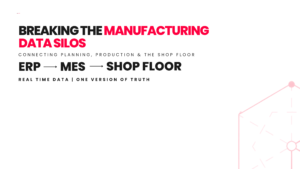
According to industry experts, all three are critical, but data fragmentation remains the single biggest barrier – closely followed by challenges in integrating legacy systems. “Most Indian manufacturing facilities operate with disconnected IT and OT systems — ERP on one side, shop floor machines on the other, and no unified layer. Because machines, assets, and daily operations generate massive data streams that remain untapped without proper infrastructure,” says Kailasam.
A surprising number of manufacturers are still running on logs that are handwritten, quality data trapped in disconnected Excel sheets, and ERP systems that don’t talk to each other.
“You cannot build intelligence on that foundation. However, the gap everyone underestimates is talent, not AI talent, but people who understand both the shop floor and the algorithm. India produces excellent data scientists and excellent manufacturing engineers. The person who is both barely exists. That intersection is where the real bottleneck sits,” says Arora.
Predictive maintenance is a major use case as it identifies and reduces chances of equipment failure frequency.
AI quality control, leading to massive reduction in manufacturing defects.
AI is also being used in supply chain & demand forecasting as well as calculating workforce productivity.
Energy management is another area that is helping to reduce significant energy costs.
Priorities for choosing the right AI partners and scaling effectively
When choosing partners and scaling, manufacturers are advised by experts to prioritize IT/OT collaboration to ensure the partner can bridge the gap between information technology (IT) and operational technology (OT). Success fails when the “data guys” don’t understand the “machine guys.”
Choose partners with documented case studies in your specific sub-sector like textiles vs. steel rather than general AI vendors.
“Choose partners with documented case studies in your specific sub-sector like textiles vs. steel rather than general AI vendors. Also prioritize partners who offer security-by-design as choosing partners who bake cybersecurity directly into the AI model,” suggests Kailasam.
Manufacturers also need to look for solutions that can evolve from simple dashboards to ‘AI agents’ capable of taking action, rather than just providing alerts.
Ask one question: does this partner care about what happens after the demo? Most AI vendors will show you a brilliant proof-of-concept and disappear before the operators on the floor have to actually use it. That’s why MIT data shows 95% of AI pilots fail to impact business metrics, not because the technology doesn’t work, but because nobody redesigned the work around it.
“A good partner will insist on defining success metrics before writing a single line of code. They’ll spend as much time with your shop floor supervisors as with your CTO. And they’ll tell you that 70% of AI value comes from people, processes, and change management, not from the model. If your AI partner only talks technology, they’re selling you the 5% that works in a lab,” informs Arora.
As Indian manufacturing deepens its AI journey, the winners will be those who move beyond pilots to disciplined execution. The focus is shifting from experimentation to embedding AI into everyday decision-making—on the shop floor, in supply chains, and across operations. Success will depend less on cutting-edge models and more on clean data, integrated systems, and people who can bridge technology with manufacturing realities. In the end, AI in manufacturing will not be defined by ambition, but by consistent, measurable outcomes delivered at scale.





of Indian enterprises still in AI pilot stage (EY–CII 2025)
of AI pilots fail to impact business metrics — not due to technology but poor adoption design (MIT data)
estimated time until full value-chain transformation becomes widespread
About India Automation Hub
India Automation Hub covers automation, robotics, and industrial technology across India and global markets. We deliver sharp, reliable reporting on the deals, deployments, and developments driving industrial transformation without the jargon.
Visit indiaautomationhub.com for industry updates and in-depth analysis.
Subscribe to our newsletter for the week’s most important automation stories, straight to your inbox.