This convergence of artificial intelligence, digital twins, and collaborative robots represents a technological evolution, fuelling alongside India’s manufacturing ambitions.
The AI Engine: From Data to Decisions
Traditional factory automation relied on rigid programming and reactive maintenance. Today, AI transforms oceans of sensor data into actionable intelligence. According to India’s Q2 2025 report, 48% of Indian manufacturers have already adopted AI tools in at least one major function, with predictive maintenance and process optimization leading the charge.
AI algorithms can analyze vibration patterns from hundreds of machines simultaneously, predicting failures weeks in advance. The system processes millions of data points hourly, identifying subtle anomalies that human operators would never catch. The result: reduced unplanned downtime and millions saved in emergency repairs.
But AI’s true power emerges when paired with complementary technologies that can act on its insights.
Digital Twins: The Virtual Mirror
Digital twins create real-time virtual replicas of physical production systems, enabling manufacturers to simulate changes before implementation. Recent case studies show dramatic results: an SPM manufacturer reduced delivery time by 30% using digital twin-enabled virtual commissioning, cutting development costs by 20% while achieving 95% accuracy between virtual and physical systems.
For a 2W electric company’s ambitious timeline—launching their largest two-wheeler plant in just eight months—digital twins played a crucial role. Engineers simulated production flows, optimized layouts, and validated control logic in the virtual realm, eliminating weeks of physical commissioning.
The technology extends beyond individual machines to entire factory ecosystems. At a top Indian auto maker’s facilities, digital twins provide real-time plant visibility, enabling operators to optimize production flows and improve quality control across multiple production lines simultaneously.
Cobots: The Human Amplifiers
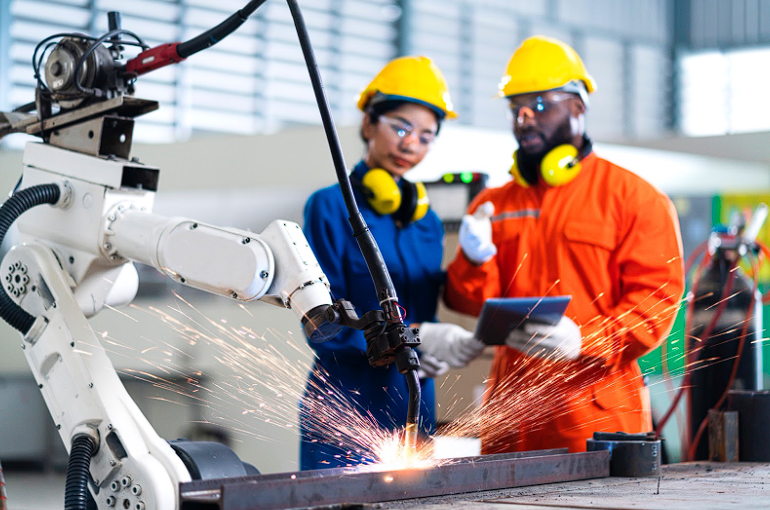
Collaborative robots bridge the gap between human creativity and mechanical precision. Unlike traditional industrial robots isolated behind safety barriers, cobots work alongside human operators, handling repetitive or ergonomically challenging tasks while humans focus on complex problem-solving.
India’s cobot adoption is accelerating rapidly. Robot installations surged 59% to 8,510 units in 2023, with automotive demand alone jumping 139% to 3,551 units. Some new launches specifically targeting the Indian market offer solutions designed for MSMEs that employ 110 million workers nationwide.
Cobots can improve productivity by up to 30% while reducing training costs through user-friendly interfaces that require minimal programming expertise.
The Convergence Effect
The real transformation occurs when these technologies intersect. AI provides the intelligence to predict and optimize. Digital twins offer risk-free testing environments. Cobots deliver flexible, safe execution. Together, they create adaptive manufacturing systems that respond intelligently to quality issues and market demands.
Consider Foxconn, which collaborated with NVIDIA to integrate humanoid robots into its manufacturing process, initially for an AI server factory in Houston, Texas, with deployment expected in early 2026. Closer to home, Dixon signed a master services agreement with an IT major to deploy AI-powered automation and smart factory services across all 24 of its manufacturing plants and six R&D centers in India.
The Path Forward
Despite impressive adoption rates, challenges persist. India’s robot density remains at just 7 units per 10,000 workers compared to the global average of 126. Even in automotive manufacturing, density reaches only 148 robots per 10,000 employees—far below South Korea’s 2,867 or Germany’s 1,500.
This gap represents opportunity. With India’s AI-in-manufacturing market growing at 58.96% CAGR toward ₹12.59 billion by 2028, and 73% of manufacturers planning AI adoption by 2025, the convergence of intelligent technologies will define competitive advantage.
As Indian manufacturers race toward the government’s $1 trillion manufacturing economy target by 2030, success won’t belong to those adopting individual technologies in isolation. Victory will favor manufacturers who orchestrate AI insights, digital twin simulations, and collaborative robotics into integrated, intelligent systems.
The future factory is automated, adaptive, predictive, and perpetually learning. And in India, that future is arriving ahead of schedule.