
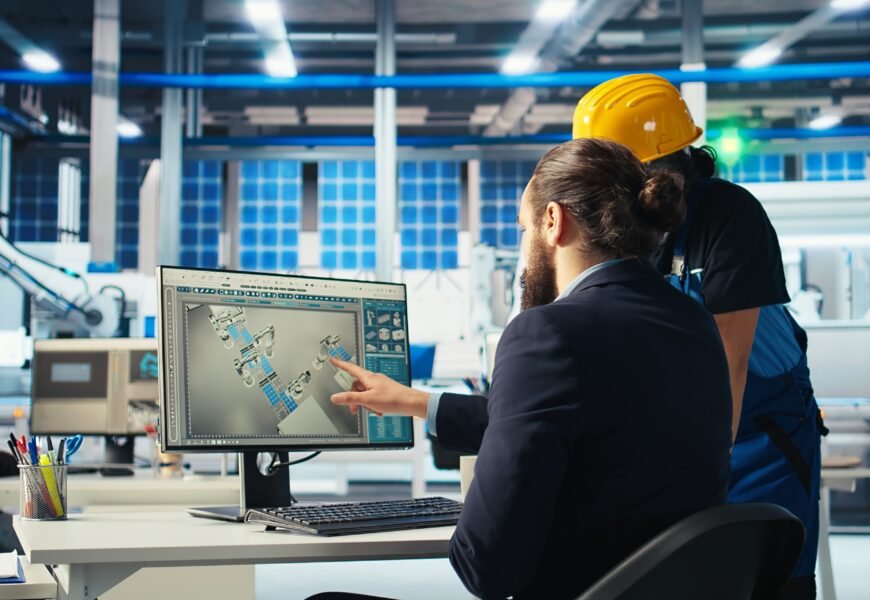
We are at a time when artificial intelligence (AI), machine learning, and robotics are fast becoming indispensable assets for businesses. It is not only the finance, banking, and e-commerce sectors where the impact is most visible to us. Even in the manufacturing sector, which encompasses many industries, AI, the Internet of Things (IoT,) and big data analytics are inspiring business owners to change how they make products in factories. Data-driven manufacturing can help companies achieve higher efficiency and profits. Many companies in India are increasingly adopting the AI-first approach, taking smart manufacturing to its next level.
What is Data-Driven Manufacturing?
Data is valuable for any business. In a manufacturing system, data is required to make better decisions. Automated machines with sensors and other systems in factories generate huge amounts of data. For example, in a tile manufacturing unit, data could pertain to Computer-Aided Design (CAD) -based tile designs, raw material tracking, kiln temperature, product defects captured by machine cameras, and so on. Data also comes from outside the shopfloor — in the form of customer feedback and R&D insights.
Studying the data helps businesses improve their operations. So, data analytics is vital for modern manufacturing, helping an organisation boost operational efficiency, achieve accuracy, predict downtime and optimise its processes.
The new wave of industrial revolution, which started a few years ago in India, saw the integration of digital systems, AI, and IoT, turning manufacturing units into smart factories.
Data-driven manufacturing refers to advanced manufacturing where real-time data is gathered and processed using technology such as AI, IoT and big data to boost productivity and efficiency.
How Can Data-Driven Manufacturing Help a Business?
Shopfloor activities in a manufacturing unit broadly include machine operations, assembly-line operations, material handling, quality control, maintenance and personnel management. Advanced software systems are integrated at various levels and across different facilities, bringing the entire organisation under one digital system so that data flows from the shopfloors to office dashboards or computers. The data from different sources can be collected, processed and analysed for business decision-making. The process is more reliable and accurate because, unlike manual data collection and analysis, there is no chance of human error.
So, how does big data analytics or data-driven manufacturing help a business?
Increased Productivity
With digitised systems, shopfloor machines can interact with other such machines. This interaction can generate data related to the rate of production, speed, and quality gaps, offering new insights to enhance productivity.
Innovation with Generative AI
Generative AI can help businesses innovate and create better products. A tile manufacturing company, for instance, can use generative AI tools to produce unique and interesting tile patterns. It can suggest numerous designs based on various parameters.
Predictive Maintenance & Uptime
Unplanned downtime can be costly for any company. Unlike traditional systems that may be fraught with errors, AI-powered systems can accurately predict machine failures and resolve maintenance issues. With timely monitoring, the IoT-enabled shopfloor systems can perform efficiently, optimising the overall process.
Improved Quality Control
AI algorithms can detect quality issues during manufacturing. Whether it is cracked tiles in a tile factory or torn fabric in a textile factory, these defects cannot escape the vision of advanced computer systems. With big data, figuring out the root cause of defects and ensuring quality consistency across locations becomes easier.
Cost Control & Savings
Data and analytics apply beyond the shopfloor activities — from the R&D and planning stage to post-production and supply-chain processes. With AI, planning and forecasting can be improved and expensive repairs can be prevented, leading to cost savings.
Resource Optimization
Through big data analytics, inventory in a factory can be managed more effectively, thereby balancing production and storage while preventing mismanagement or wastage. This is achieved by using data to predict demand and set production schedules.
How Do Shopfloor Dashboards Work?
Understanding Industrial IoT (IIoT) Systems
The physical systems in a shopfloor, such as machinery, devices and other equipment, are based on Industrial Internet of Things (IIoT), like sensors and small electronic components called RFID tags. These elements store information such as performance, location and physical condition.
Shopfloor Dashboard Displays
Shopfloor dashboards are digital interfaces, like a TV screen, that display the key performance indicators (KPIs) or real-time manufacturing data in a factory. These dashboards, which are modern replacements of paper charts and whiteboards, are integrated with a central dashboard or interface that administrators and office employees can access.
Data Analytics & Real-Time Insights
Data-driven manufacturing brings data analytics platforms into play. Using big data analytics tools, shopfloor managers can get a clearer picture of how things are moving and get insights from their meeting rooms instead of visiting the factory.
Cloud Computing Infrastructure
And what enables these systems to handle and process such a huge amount of data? It is cloud computing. The data stays in the cloud and the physical systems interact in real-time using the cloud.
Challenges to Overcome in Data-Driven Manufacturing
Infrastructure & System Integration
Data-driven manufacturing is here to transform shopfloor operations, providing businesses with countless ways to use data to improve productivity and efficiency. However, every innovation comes with its unique challenges. One area where some companies may face challenges is investing in upgraded systems for seamless data integration.
Cybersecurity & Data Protection
Another challenge is the increased risk of security breaches when handling large-scale data. The risk is reduced if a strong cybersecurity system is in place. Moreover, as data is managed over complex, interlinked devices, secure storage is vital for companies so they can avoid risks.
Talent & Training Investment
Finally, companies must invest in new talent — people who can work on complex datasets. The cost of infrastructure and training people could be a challenge, especially for small-scale manufacturers.
Key Takeaways: The Future of Smart Manufacturing
Big data, with its vastness and complexity, will push industries to adopt AI and newer technologies to achieve faster and more streamlined processes. Data-driven decisions are more accurate and reliable and many companies have started to realise this fact. Technology, together with talented people, can help companies take their businesses to newer heights.