Context
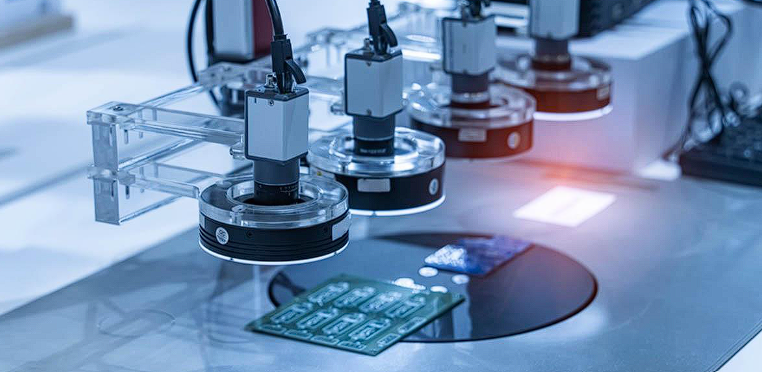
Humans once scanned machined parts for blemishes. Now, a tripod of cameras and a small robot arm add precision to the task. A high-resolution image flashes on a monitor as the cameras sweep the line; a tiny hairline crack blinks red in the software.
This is the promise of a modern vision stack — a layered system of optics, processors, and algorithms that lets machines see like a human eye, or better. For India’s factories, where margins are tight and defect tolerance is zero, such “machine vision” is moving closer to the assembly line.
Why Now – A Smart-Eyed Revolution
Across Indian manufacturing, rising quality demands and global competition are driving a shift from manual inspection to automated vision. Analysts project India’s machine-vision market will surpass US $4.8 billion by 2030, driven by AI, robotics, and low-cost sensors.
Hardware such as high-speed cameras and lighting systems has become more affordable, while deep-learning algorithms now detect defects with greater accuracy. Government initiatives like Make in India and PLI (Production Linked Incentive) have accelerated domestic production of sensors, chips, and control systems that power these vision layers.
Smartphone output, for instance, has jumped from about 58 million units in 2014 to 330 million in 2024 — seeding a local supply base for vision hardware. The same electronics ecosystem that powers India’s consumer devices is now enabling its factories to see better.
Inside the Vision Stack – Where Hardware Meets AI
A vision stack combines industrial cameras (2D, 3D, thermal, or spectral), illumination systems, and edge processors running AI models. The stack captures, processes, and interprets visual data — from detecting surface defects on steel sheets to counting pharmaceutical tablets.
Global integrators like Cognex and Keyence provide turnkey modules, while Indian firms such as Tata Elxsi, Qualitas, and Bosch India build customized solutions for automotive and FMCG clients.
The fastest innovation is in the software layer — open-source tools like OpenCV and TensorFlow, coupled with new edge-AI chips, have drastically reduced development time.
Startups are now pushing the frontier with human-like perception systems that allow robots to “see and grasp any object without prior training,” using color, motion, and depth to pick items from clutter — integrating seamlessly into production cells.
The Ecosystem Expands
India’s machine vision ecosystem is becoming denser and more collaborative. While automotive and electronics remain the early adopters, sectors such as food processing and packaging are catching up.
Some global players have begun localizing manufacturing, while Indian startups experiment with low-cost, modular systems for SMEs.
The Indian Machine Vision Association (IMVA) now connects vendors, integrators, and users — fostering common standards. Venture funding, too, is flowing in, with key startups raising growth rounds in the past two years to commercialize their vision-guided platforms.
Policy support continues to strengthen. The National Robotics Mission identifies AI and machine vision as strategic technologies, while R&D centers under the Ministry of Heavy Industries develop low-cost inspection modules. Together, domestic hardware production and India’s AI talent pool could make the country a serious exporter of machine vision subsystems within the decade.
Challenges – When Vision Turns Hazy
High upfront costs remain a major hurdle — full-stack systems (cameras, lighting, compute) can cost several lakh rupees. For SMEs, the ROI horizon often appears distant.
The skills gap is another constraint: vision engineers and AI technicians are scarce, forcing firms to depend on imported expertise.
Legacy infrastructure worsens integration challenges — many Indian plants still rely on decades-old PLCs and limited connectivity, requiring custom coding and repeated calibration.
Moreover, machine vision thrives on clean, labeled image data — something few factories systematically collect. Without disciplined data practices, AI models remain fragile, misclassifying defects or missing subtle variations.
The Road Ahead – Eyes on the Prize
Despite hurdles, the momentum is undeniable. Manufacturers are beginning with small steps — automating a single inspection line — and expanding once ROI is proven. Early adopters report measurable productivity gains and consistent quality, particularly in high-precision industries.
The next phase will see plug-and-play smart cameras with built-in AI chips and cloud connectivity. A new wave of “vision-as-a-service” startups is emerging, offering subscription-based models instead of heavy capital expenditure.
The true inflection point will come when machine vision becomes invisible — not an add-on, but an expected layer of every smart factory.
As one analyst notes, the goal is to make vision “ubiquitous, invisible, and indispensable.”
If India aligns its hardware manufacturing, policy support, and skills ecosystem, its factory floors will soon be filled with machines that don’t just work — they see.