







AI in Manufacturing: Practical Use Cases Every CXO Should Pay Attention To
Artificial intelligence (AI) has quickly become the loudest topic in manufacturing boardrooms. Every conference panel talks about it, every technology vendor claims to offer it, and every strategic...


Table Of Content
Artificial intelligence (AI) has quickly become the loudest topic in manufacturing boardrooms. Every conference panel talks about it, every technology vendor claims to offer it, and every strategic roadmap seems to include it.
Yet for many CXOs, the question remains surprisingly simple: Where does AI actually deliver real operational value?
At present, many AI conversations are still wrapped in technical jargon and futuristic promises. Machine learning models, neural networks, and highly advanced algorithms may sound impressive, but they usually feel disconnected from the everyday realities of running factories, managing production schedules, and protecting operational margins. Manufacturing leaders do not need more buzzwords. They need outcomes.
Where AI is proving its value today is in solving very practical problems like preventing equipment failures, improving product quality, strengthening supply chain planning, and allowing faster operational decisions. The companies quietly deploying AI in these areas are already seeing considerable progress in reliability, efficiency, and cost control.
For CXOs evaluating AI investments, the most important question is not whether AI matters. It is where it delivers immediate and measurable impact.
Here are some of the most practical use cases where AI is already reshaping manufacturing operations.
Predictive Maintenance – Moving Beyond ‘Fix It When It Breaks’
Equipment failure remains one of the most expensive operational disruptions in the manufacturing sector. A single unexpected machine breakdown can stop an entire production line, delay shipments, and disrupt customer commitments.
Historically, most factories have relied on two maintenance strategies: Reactive repairs after equipment fails or scheduled maintenance based on fixed service intervals.
Both approaches have limitations. Reactive maintenance leads to costly downtime, while scheduled maintenance often replaces parts that still have usable life.
AI introduces a far more precise approach through predictive maintenance.
Modern machines already generate large volumes of sensor data – vibration signals, temperature readings, acoustic signatures, pressure levels, and operational cycles. AI systems analyse these signals continuously and detect subtle patterns that indicate early stages of wear or malfunction.
For instance, if a Computer Numerical Control (CNC) machine spindle begins showing abnormal vibration patterns, the AI system can flag the anomaly weeks before the component actually fails. Maintenance teams can then replace the part during a planned service window rather than halting production during a critical shift.
For CXOs, the impact is simple. It results in fewer production interruptions, longer equipment life, and more predictable maintenance costs. In fact, many manufacturers implementing predictive maintenance have reported notable reductions in unplanned downtime.
AI-Powered Quality Inspection – The Unblinking Eye on the Production Line
Quality control has always been essential in manufacturing. However, traditional inspection processes come with unavoidable limitations. Human inspectors, even skilled, cannot maintain perfect concentration across long production shifts. Small defects can easily go unnoticed, especially when inspection speeds increase.
Many factories also rely on statistical sampling, inspecting only a fraction of produced items rather than every unit.
AI-powered computer vision systems are changing this approach.
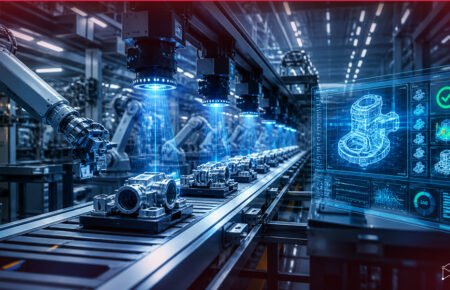
Using high-resolution cameras and machine learning models, these systems inspect products continuously as they move through the production line. Every unit is analysed in real time, and even the smallest defects can be detected immediately.
For instance, an AI vision system inspecting automotive components can detect microscopic surface scratches, misaligned parts, or assembly errors that may be difficult for human inspectors to identify consistently. The system instantly flags defective products so that they can be removed before moving further down the production process.
For CXOs, the advantages extend beyond quality assurance. Early defect detection reduces scrap, minimises rework, and lowers the risk of defective products reaching customers. Over time, this results in lower operational losses and stronger product reliability.
AI-Driven Operational Workflows
Another emerging use of AI in manufacturing is automating operational responses once a problem has been identified.
Earlier AI systems focused mainly on generating alerts. Modern AI platforms increasingly connect with other operational systems to trigger actions automatically.
Just think of a scenario where an AI system detects abnormal vibration patterns in a production machine. Instead of simply sending an alert, the system can automatically create a maintenance ticket, check the availability of spare parts in the enterprise resource planning (ERP) system, and notify the appropriate technician.
In some cases, it can even adjust production schedules to reduce disruption while the maintenance work is performed.
For manufacturing organisations managing large and complex facilities, this ability to connect insights with automated workflows can reduce response times and strengthen operational coordination.
Manufacturers Pulling Ahead
AI is no longer confined to experimental pilots or innovation labs. It is steadily becoming embedded within the operational infrastructure of modern manufacturing facilities.
As adoption grows, the industry is beginning to split into two groups. Some organisations continue to observe from the sidelines, waiting for AI technologies to mature further. Others are already applying AI to real operational challenges across maintenance, quality control, and supply chain planning.
The difference between these approaches may define the next phase of manufacturing competitiveness.
Factories that begin integrating AI into their operational systems today are learning faster, responding to disruptions more quickly, and extracting greater value from the data already generated across their production environments.
For CXOs navigating increasingly complex manufacturing ecosystems, that capability may soon become less of an advantage and more of a necessity.