







Cross-Industry Automation Trends: Adapting Technologies Across Manufacturing Sector
In the global manufacturing landscape, staying competitive means more than doing what your sector always did. Today’s smart factories borrow ideas from entirely different industries—and that trend...

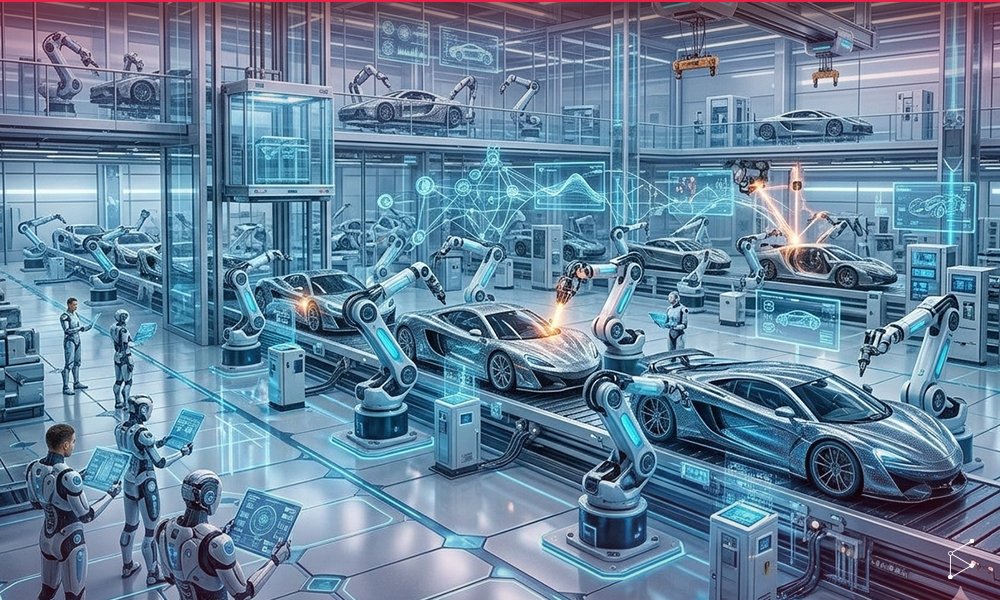
In the global manufacturing landscape, staying competitive means more than doing what your sector always did. Today’s smart factories borrow ideas from entirely different industries—and that trend holds real relevance for Indian manufacturers too. With rising cost pressures, ageing equipment and a diverse mix of raw-material, textiles, automotive, food & beverage players, Indian operations are ripe for technology transfer from sectors such as aerospace, pharmaceuticals and high-volume electronics. What’s driving the change? First: the collapse of walls between sectors. Technologies originally rolled out in automotive are now showing up in packaging lines, textile finishing plants and food processing units. Second: plant managers are hungry for operational gains—reduced downtime, higher throughput, better quality—with limited capex. Borrowing proven solutions from another industry reduces risk. Third: India’s position as a supplier base to global OEMs means system integrators and automation providers are already acting as cross-industry conduits. In this article we unpack five key trends in cross-industry automation-technology adoption, explain why they matter operationally, and show what Indian manufacturers and integration partners should focus on next. It is undeniably clear that the primary goal here is to turn ideas into actions shop-floor – technology is driving innovations and trends not just in the manufacturing sector but across industries.
Data-Driven Operations Becoming Universal (AI/ML + Predictive Insights)
Data is driving humanity and their activities today. From designing products that meet demands and customer dynamics, to engaging feasible plans and appropriate resources, data analytics is at the center of it all. It was once limited to high-tech plants, but many firms and agencies have now adopted it across FMCG, metal-fab, packaging, textiles. The adoption of AI has been linked to major gains in a vast array of areas, including improving uptime, enhancing quality and reducing defects [1]. Data is at the center of understanding market dynamics, competitive landscapes, and even managing supply chains. “Data-centric AI” approach has become central to most operations and practices in industrial analytics. Studies show that manufacturers can also now use elements such as logs, acoustics, images, multisensory data to better inform decisions and improvements [2]. With these merging innovations, predictive maintenance has become transferable across sectors:
- Manufacturers can now use metal-forming press line to log vibration/temperature/current of operations and inputs in order detect faults earlier enough for competent interventions.
For integrators: modular analytics frameworks reusable across industries creates competitive advantage.
Robotics Moving Beyond Automotive (Cobots, Material Handling Bots, Low-Capex Models)
Robotics no longer belongs exclusively to high-volume automotive lines. Today, manufacturers across sectors—including packaging, textiles, food & beverage and electronics—are deploying robots in ways adapted to their specific constraints. In one recent study, the adoption of industrial robots was linked to improved labor-allocation efficiency via structural manufacturing upgrades [3]. For example, a collaborative robot (cobot) originally designed for light-assembly in electronics is now being deployed in Indian SME packaging lines for pick-and-place and pallet-ising tasks. These cells require minimal fencing, can be re-programmed quickly and support frequent product change-overs—ideal when product runs are short and variety is high. What’s critical for the operations manager is that the technology is mature and lower risk: by borrowing from sectors where block volumes justified the investment, other sectors now benefit from lower cost, plug-and-play robotics.
Operational gains appear in three forms:
- Flexibility: Cobots or mobile robots allow quick layout changes when product mix shifts, reducing downtime between change-overs, which is especially relevant in multi-product Indian lines.
- Cost control: If an automation solution has already succeeded in one sector, system integrators can adapt it for another without reinventing the wheel. That means lower engineering cost, faster commissioning, and faster ROI.
For Indian automation providers and integrators: target robots and automation kits that already have proof-points in one sector and pitch them into another (for example, a food-packaging line that borrows from electronics assembly). For plant operations: begin with a low-capex pilot cell rather than a full line overhaul—learning, adapting and scaling once the benefits are clear
Standardization & Interoperability (IIoT, OPC-UA, MQTT)
In the past, each manufacturing sector built its automation stack in isolation—proprietary devices, closed protocols, little chance of reuse. That’s changing fast. Standardized connectivity protocols, middleware and device frameworks now enable cross-industry adaptation of solutions. In one recent paper, interoperability middleware for IoT gateways based on international standard ontologies was shown to simplify asset integration across heterogeneous systems. [4] Another found that standard mapping between digital twin frameworks supports seamless data exchange across domains [5]. Why does this matter operationally for manufacturers? Because the cost and risk of integration are often more painful than the hardware cost. If a new sensor network uses a standard protocol, the same system integrator can apply it in a chemical plant, then in textiles, then in a food processing line—reducing custom integration cost and accelerating deployment.
In the Indian context: many factories run legacy equipment and equipment from multiple vendors. An integrator that knows how to bridge old and new systems using standard-based gateways will deliver much faster value. For plant operations: this means less downtime during upgrades, fewer integration surprises, and faster ramp-up of data-driven workflows.
Sustainability-Driven Automation (Energy, Waste, Emissions)
Climate change and global warming is threatening the stability of the global community, and sustainability is now the only solution. It has become not only a reporting metric but also an operational driver in most agencies and corporations. Studies show that AI-based energy-optimization systems can reduce manufacturing energy consumption by helping to detect inefficiencies that would otherwise be hidden to traditional monitoring systems [6]. In this same regard, leveraging IoT-based systems to monitor operations can help to reduce resource waste and environmental impact [7]. In this regard, Indian manufacturers should now embrace these innovative systems in order to address existing issues that are commonly associated with rising electricity tariffs across textiles, forging, FMCG, packaging. Thus, they should embrace the following automation examples and migrating away from chemicals/pharma to mid-sized Indian plants:
- real-time utilities monitoring,
- emissions sensors,
- smart energy metering.
Conclusion
To conclude, Indian manufacturers and their plants must develop a hybrid factory mindset. Besides, competitive manufacturers are those who borrow best ideas from any industry —they leverage predictive maintenance from automotive, AR from aerospace, energy optimization from chemicals. Also, a cross-industry adaptation of this mindset and the associated innovations would deliver higher productivity, safety, sustainability and innovation speed. These technologies have already been proven elsewhere, and Indian factories must adapt them with the right partners and pilots to also achieve the desired benefits.
Reference List
[1] Yan Pang, Teng Huang, Qiong Wang. AI and Data-Driven Advancements in Industry 4.0. Sensors, 25(7), 2249, 2025.
[2] S. Atif. The role of Industry 4.0-enabled data-driven shared value in manufacturing firms. Business Strategy and Development, 2023.
[3] K. Wu. A study on the impact of industrial robot applications on labour misallocation. Systems, 13(7), 569, 2025.
[4] P. H. M. Pereira. Interoperability middleware for IIoT gateways based on ontologies. Journal of Industrial Information Integration, 2023.
[5] C. Schmidt. Increasing interoperability between Digital Twin standards and specifications: Transformation of DTDL to AAS. Sensors, 23(18), 7742, 2023.
[6] M. Al-Emran. Artificial intelligence integration in industry: Implications for sustainable manufacturing. Sustainability, 15(4), 2023.
[7] D. B. Pham. Smart manufacturing for sustainability: Waste minimization using IoT-based monitoring systems. Journal of Cleaner Production, 363, 2022.
[8] D. G. Petrick. Effectiveness of augmented reality for industrial maintenance tasks. Applied Sciences, 12(10), 2022.
[9] Y. R. Hsu, C. Wu. Digital work instructions and worker performance in smart manufacturing. International Journal of Production Research, 60(22), 2022.